Edexcel IGCSE Chemistry The Periodic Table questions

Revise the key specification points for The Periodic Table, then try focused exam-style questions with worked explanations.

Edexcel IGCSE Chemistry Subtopic 1.d

What You Need To Know

The Periodic Table questions can test recall, explanation, calculations, practical method, or data handling. For this subtopic, you should be able to:

  • 1.18 understand how elements are arranged in the Periodic Table: in order of atomic number in groups and periods.
  • 1.19 understand how to deduce the electronic configurations of the first 20 elements from their positions in the Periodic Table
  • 1.20 understand how to use electrical conductivity and the acid-base character of oxides to classify elements as metals or non-metals
  • 1.21 identify an element as a metal or a non-metal according to its position in the Periodic Table
  • 1.22 understand how the electronic configuration of a main group element is related to its position in the Periodic Table
  • 1.23 understand why elements in the same group of the Periodic Table have similar chemical properties
  • 1.24 understand why the noble gases (Group 0) do not readily react

How To Answer The Periodic Table Questions

  1. Start by identifying exactly which specification point the question is testing.
  2. Use the command word carefully: state and identify need a direct answer, while describe and explain need linked detail.
  3. For tables, graphs, diagrams, and practical questions, quote the relevant observation or reading before drawing a conclusion.
  4. When a question asks for a calculation, show the key substitution and include units where they are needed.

Example Questions With Worked Explanations

Example 1: Explaining the Chemistry

Question 1

The diagram shows the positions of some elements in part of the Periodic Table.
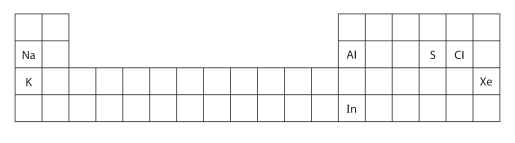
Partial Periodic Table diagram showing Na above K on the left, and in the right block Al above In, with S and Cl in the same period as Al, and Xe at the far right.

Explain which element in the diagram is unreactive.

Final answer

Xe (xenon) is unreactive because it has a full outer shell of electrons.

Mark scheme points

  1. M1 Identify the element as Xe or xenon.
  2. M2 Explain that it has a full outer shell of electrons.

Explanation

To get both marks, you need the element and the reason.

  • The unreactive element shown is Xe, which is xenon.
  • Xenon is unreactive because it has a full outer shell of electrons.
  • A full outer shell makes the atom stable, so it does not easily gain, lose, or share electrons.

So the best exam answer is: Xe, because it has a full outer shell of electrons.

Common mistakes

  • Writing only Xe and giving no explanation. That gets the identification mark but not the second mark.
  • Saying only “it is stable” without linking this to a full outer shell.
  • Choosing an element that is not unreactive, such as Cl or S.
  • Confusing xenon with Group 7; xenon is a noble gas, not a halogen.
  • Examiners reported that most candidates found Xe, but some lost the second mark by not explaining it in terms of the outer shell. A surprising number also wrongly placed it in Group 7.

Example 2: Core Knowledge

Question 2

In the Periodic Table, the vertical columns of elements are called groups. The table gives some information about the first four elements in Group 0.
Element Relative atomic
mass (Ar)
Boiling point
in °C
helium 4 –269
neon 20 –246
argon 40 –186
krypton 84 –153
State the relationship between the relative atomic mass and the boiling point
of these elements.

Final answer

The greater the relative atomic mass, the higher the boiling point.

Mark scheme points

  1. M1 State that as relative atomic mass increases, boiling point increases (positive correlation).

Explanation

To get the mark, describe the trend shown by the values in the table.

  • Helium has the smallest relative atomic mass and the lowest boiling point.
  • Krypton has the largest relative atomic mass and the highest boiling point.
  • So the relationship is: higher relative atomic mass gives higher boiling point.

You can also say the boiling point becomes less negative as relative atomic mass increases, but the simplest exam answer is “higher boiling point”.

Common mistakes

  • Giving only one example from the table instead of the overall relationship.
  • Saying the boiling point gets lower because the temperatures are negative.
  • Talking about group number or atomic number instead of relative atomic mass.

Practise This Subtopic

Build a focused practice set on the periodic table, with questions selected from this part of the Edexcel IGCSE Chemistry specification.