Edexcel IGCSE Chemistry Metallic bonding questions

Revise the key specification points for Metallic bonding, then try focused exam-style questions with worked explanations.

Edexcel IGCSE Chemistry Subtopic 1.h

What You Need To Know

Metallic bonding questions can test recall, explanation, calculations, practical method, or data handling. For this subtopic, you should be able to:

  • 1.52C know how to represent a metallic lattice by a 2-D diagram
  • 1.53C understand metallic bonding in terms of electrostatic attractions
  • 1.54C explain typical physical properties of metals, including electrical conductivity and malleability

How To Answer Metallic bonding Questions

  1. Start by identifying exactly which specification point the question is testing.
  2. Use the command word carefully: state and identify need a direct answer, while describe and explain need linked detail.
  3. For tables, graphs, diagrams, and practical questions, quote the relevant observation or reading before drawing a conclusion.
  4. When a question asks for a calculation, show the key substitution and include units where they are needed.

Example Questions With Worked Explanations

Example 1: Core Knowledge

Question 1

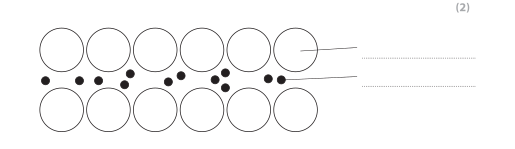
This question is about magnesium metal and its compounds. The diagram represents the structure of magnesium.
Complete the diagram by adding the labels. Metallic bonding diagram for magnesium: regular array of large circles (positive metal ions) with small dots between them representing delocalised electrons; two label lines point to a circle and to the dots.
Final answer

  • Large circles: positive ion (cation)
  • Small dots: delocalised electron

See labelled diagram:

positive ion delocalised electron

Mark scheme points

  1. M1 Label a large circle as a positive ion / cation.
  2. M2 Label the small dots as delocalised electron(s).

Explanation

  • For the large circles, write positive ion or cation. In a metal lattice, the metal atoms have formed positive ions.
  • For the small dots, write delocalised electron. These electrons are free to move through the metal.
  • Checklist for full marks:
    • large circle = positive ion / cation
    • small dot = delocalised electron

Common mistakes

  • Examiners reported that most candidates got at least one mark, but a common trap was calling the large circles protons or nuclei instead of positive ions.
  • Do not swap the labels: the small dots are the electrons.
  • Do not write negative ion for the large circles; metals contain positive ions and delocalised electrons.
  • Avoid writing just magnesium; use the particle name, ideally positive ion.

Example 2: Using Data and Practical Skills

Question 2

The diagram represents the structure of copper metal. Diagram of metallic bonding in copper: a lattice of positive metal cations surrounded by delocalised electrons. Explain three properties of copper that make it a suitable metal to use in electrical wiring.

Final answer

  • Copper conducts electricity because its delocalised electrons can move through the metal.
  • Copper is ductile, so it can be drawn into wires, because layers of positive metal ions can slide over each other.
  • Copper has a high melting point because there is a strong electrostatic attraction between the positive ions and the delocalised electrons.

Mark scheme points

Any five of these score full marks.

  1. M1 Copper conducts electricity.
  2. M2 Delocalised electrons can move / flow through the structure.
  3. M3 Copper is malleable / ductile.
  4. M4 Copper has layers of cations / atoms.
  5. M5 These layers can slide / slip / move over each other.
  6. M6 Copper has a high melting point.
  7. M7 There is strong electrostatic attraction between cations and delocalised electrons.

Explanation

To secure full marks, give a property and then link it directly to metallic bonding. The safest answer is to explain all three useful properties.

  • Electrical conductivity: say that copper conducts electricity because the delocalised electrons can move through the metal structure.
  • Ductility / malleability: say that copper has layers of positive ions and these layers can slide over each other, so the metal can be shaped into wires.
  • High melting point: explain this by the strong electrostatic attraction between the positive ions and the delocalised electrons, so a lot of energy is needed to overcome it.

If you only name properties without explaining them, you will not get all the marks.

Common mistakes

  • Examiners reported that many candidates lost the conductivity explanation mark by forgetting to say that delocalised electrons move, or by incorrectly saying that ions move.
  • Do not say that ions or atoms move to carry electricity; for conductivity, it is the delocalised electrons that move.
  • Do not just write ductile or malleable; add that the layers can slide over each other.
  • Properties such as shiny, cheap, unreactive, hard or strong are ignored here.
  • Avoid talking about covalent bonding, ionic bonding or intermolecular forces; this is a metallic bonding question, and wrong bonding ideas can limit the marks.

Practise This Subtopic

Build a focused practice set on metallic bonding, with questions selected from this part of the Edexcel IGCSE Chemistry specification.