Edexcel IGCSE Chemistry Elements, compounds and mixtures questions

Revise the key specification points for Elements, compounds and mixtures, then try focused exam-style questions with worked explanations.

Edexcel IGCSE Chemistry Subtopic 1.b

What You Need To Know

Elements, compounds and mixtures questions can test recall, explanation, calculations, practical method, or data handling. For this subtopic, you should be able to:

  • 1.8 understand how to classify a substance as an element, compound or mixture
  • 1.9 understand that a pure substance has a fixed melting and boiling point, but that a mixture may melt or boil over a range of temperatures
  • 1.10 describe these experimental techniques for the separation of mixtures: simple distillation fractional distillation filtration crystallisation paper chromatography.
  • 1.11 understand how a chromatogram provides information about the composition of a mixture
  • 1.12 understand how to use the calculation of Rf values to identify the components of a mixture
  • 1.13 practical: investigate paper chromatography using inks/food colourings

How To Answer Elements, compounds and mixtures Questions

  1. Start by identifying exactly which specification point the question is testing.
  2. Use the command word carefully: state and identify need a direct answer, while describe and explain need linked detail.
  3. For tables, graphs, diagrams, and practical questions, quote the relevant observation or reading before drawing a conclusion.
  4. When a question asks for a calculation, show the key substitution and include units where they are needed.

Example Questions With Worked Explanations

Example 1: Core Knowledge

Question 1

Salt is soluble in water, but sand is insoluble in water. This difference allows a mixture of salt and sand to be separated using this apparatus.
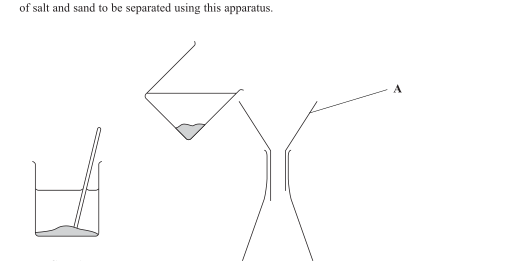
Diagram of separation apparatus in three steps: Step 1 shows a container where a salt-and-sand mixture is stirred with water; Step 2 shows the mixture being poured through a funnel containing filter paper into a receiving flask/beaker leaving sand as residue; Step 3 shows the filtrate (salt solution) transferred to an evaporating basin and heated so water evaporates leaving salt.

Use words from the box to complete the sentences. Each word may be used once, more than once or not at all.

In Step 1, the mixture of salt and sand is placed in a containing and stirred with a

In Step 2, the mixture from Step 1 is poured through a into a

In Step 3, the liquid is transferred to a basin to allow the to be removed.

Words: beaker, Bunsen burner, burette, conical flask, funnel, glass rod, thermometer, water

Final answer

In Step 1, the mixture of salt and sand is placed in a beaker containing water and stirred with a glass rod.

In Step 2, the mixture from Step 1 is poured through a funnel into a conical flask.

In Step 3, the liquid is transferred to a basin to allow the water to be removed.

Mark scheme points

  1. M1 beaker
  2. M2 water
  3. M3 glass rod
  4. M4 funnel
  5. M5 conical flask
  6. M6 water

Explanation

Match each blank to the apparatus or substance shown in the separation process.

  • First, the mixture goes into a beaker. The liquid added is water, because salt dissolves in water but sand does not.
  • The mixture is stirred with a glass rod.
  • Next, the mixture is filtered through a funnel.
  • The liquid that passes through is collected in a conical flask.
  • Finally, the liquid is heated in a basin so that the water is removed, leaving the salt behind.

To get all 6 marks, use the exact words from the box and notice that water is needed twice.

Common mistakes

  • Writing Bunsen burner instead of glass rod for stirring in Step 1.
  • Putting beaker instead of conical flask for the container in Step 2.
  • Forgetting that water can be used more than once.
  • Choosing apparatus from the box that are not used here, such as burette or thermometer.
  • In Step 3, writing the heating apparatus instead of the substance removed; the missing word is water.
Example 2: Using Data and Practical Skills

Question 2

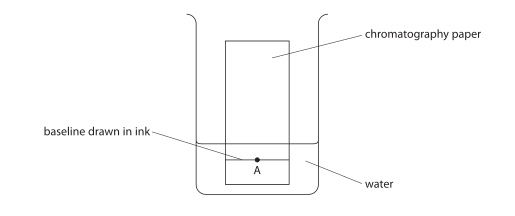
A student uses this apparatus to investigate the dyes in a food colouring A. Paper chromatography setup: beaker with water (solvent) at the bottom; chromatography paper dipping into water; a baseline is drawn in ink and a spot of food colouring A is on the baseline. The baseline and/or spot appears below the solvent level in the incorrect setup. Explain two mistakes that the student makes when setting up the apparatus.

Final answer

  • The baseline has been drawn in ink. It should be drawn in pencil, because the ink can dissolve and interfere with / contaminate the results.
  • The water level is above the baseline (and spot A). This means A will dissolve or mix into the water / wash off the paper instead of travelling up the paper properly.

Mark scheme points

  1. M1 Baseline has been drawn in ink.
  2. M2 The ink would interfere with / contaminate the results.
  3. M3 The water level is above A / above the baseline.
  4. M4 Therefore A will mix with / dissolve in the water.

Explanation

To get full marks, identify each mistake and explain why it is a problem.

  • First, the baseline is wrong because it is drawn in ink. In chromatography, the baseline should be in pencil. If ink is used, it can dissolve in the solvent and produce extra colours or smudging, so the chromatogram is contaminated.
  • Second, the solvent level is too high because it is above the baseline / spot A. The sample spot must start above the solvent. If the spot is under the water, the food colouring dissolves straight into the solvent and washes off instead of separating up the paper.

A strong exam answer uses both the mistake and the consequence, for example: “baseline drawn in ink, so it will interfere with results” and “water above the baseline, so A dissolves in the water.”

Common mistakes

  • Examiners reported that many students spotted both errors but did not explain them clearly enough. Naming the mistake alone is not enough; add the reason it affects the result.
  • Saying the water should be in line with the baseline is wrong. The solvent must be below the baseline.
  • Do not just say “the baseline is wrong” — say it is drawn in ink and that the ink can dissolve.
  • Do not say the problem is that a lid is missing. That does not earn credit here.
  • Do not suggest changing the solvent as one of the setup mistakes; the credited errors are the ink baseline and the solvent level.

Practise This Subtopic

Build a focused practice set on elements, compounds and mixtures, with questions selected from this part of the Edexcel IGCSE Chemistry specification.