Edexcel IGCSE Chemistry Atomic structure questions

Revise the key specification points for Atomic structure, then try focused exam-style questions with worked explanations.

Edexcel IGCSE Chemistry Subtopic 1.c

What You Need To Know

Atomic structure questions can test recall, explanation, calculations, practical method, or data handling. For this subtopic, you should be able to:

  • 1.14 know what is meant by the terms atom and molecule
  • 1.15 know the structure of an atom in terms of the positions, relative masses and relative charges of sub-atomic particles
  • 1.16 know what is meant by the terms atomic number, mass number, isotopes and relative atomic mass (Ar)
  • 1.17 be able to calculate the relative atomic mass of an element (Ar) from isotopic abundances

How To Answer Atomic structure Questions

  1. Start by identifying exactly which specification point the question is testing.
  2. Use the command word carefully: state and identify need a direct answer, while describe and explain need linked detail.
  3. For tables, graphs, diagrams, and practical questions, quote the relevant observation or reading before drawing a conclusion.
  4. When a question asks for a calculation, show the key substitution and include units where they are needed.

Example Questions With Worked Explanations

Example 1: Using Data and Practical Skills

Question 1

The diagram represents an atom of an element.
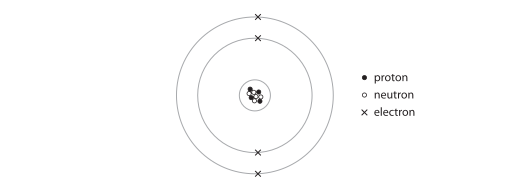
Bohr model atom diagram with a nucleus containing 4 protons and 5 neutrons (key shows proton, neutron, electron). Two electron shells are shown with 2 electrons in the first shell and 2 electrons in the second shell.

Use numbers from the box to complete the table.

You may use each number once, more than once or not at all.

2  4  5  9  10
Atomic number of this atom
Mass number of this atom
Period number of this element
Number of electrons in the 2+ ion formed from this atom

Final answer

Atomic number of this atom 4
Mass number of this atom 9
Period number of this element 2
Number of electrons in the 2+ ion formed from this atom 2

Mark scheme points

  1. M1 Atomic number = 4
  2. M2 Mass number = 9
  3. M3 Period number = 2
  4. M4 Number of electrons in the 2+ ion = 2

Explanation

  • The atomic number is the number of protons in the nucleus. The diagram shows 4 protons, so the atomic number is 4.
  • The mass number is the total number of protons and neutrons. Here there are 4 protons + 5 neutrons = 9.
  • The period number is the number of occupied electron shells. The atom has electrons in 2 shells, so the period number is 2.
  • A 2+ ion has lost 2 electrons. The atom has 4 electrons to start with, so the ion has 4 − 2 = 2 electrons.
mass number = protons + neutrons
             = 4 + 5
             = 9

electrons in 2+ ion = 4 - 2
                    = 2

Common mistakes

  • Using the number of neutrons for the atomic number. Atomic number is always protons.
  • Forgetting that mass number is protons + neutrons, not just one of them.
  • Mixing up period number with outer-shell electrons. Period number is the number of occupied shells.
  • Examiners reported that the last part was the hardest: many candidates got the first three answers right but then gave 4 electrons, which is the number in the neutral atom, not in the 2+ ion.

Example 2: Using Data and Practical Skills

Question 2

The diagram represents an atom of element Z.

Z is not the symbol of the element.

Bohr model diagram of atom Z showing 3 electron shells with 2 electrons in the first shell, 8 electrons in the second shell, and 2 electrons in the third (outer) shell.

A sample of element Z contains three isotopes. The table shows the numbers of particles in the nucleus of each isotope and the percentage abundance of each isotope.

Isotope Number of protons Number of neutrons Percentage abundance
1 12 12 79.0
2 12 13 10.0
3 12 14 11.0

Use the information in the table to calculate the relative atomic mass (Ar) of element Z.

Give your answer to one decimal place.

Ar =

Final answer

Mass numbers = 24, 25, 26

Ar = (79.0 × 24 + 10.0 × 25 + 11.0 × 26) / 100
      = 2432 / 100
      = 24.32

Ar = 24.3

Mark scheme points

  1. M1 Use the isotopic masses 24, 25 and 26.
  2. M2 Calculate the weighted total: 79.0 × 24 + 10.0 × 25 + 11.0 × 26 = 2432.
  3. M3 Divide by 100 to find the relative atomic mass: 2432 / 100 = 24.32.
  4. M4 Give the answer to one decimal place: 24.3.

Explanation

First find the mass number of each isotope:

isotope 1: 12 protons + 12 neutrons = 24
isotope 2: 12 protons + 13 neutrons = 25
isotope 3: 12 protons + 14 neutrons = 26

Then calculate the weighted mean, because the isotopes are not present in equal amounts.

(79.0 × 24) + (10.0 × 25) + (11.0 × 26)
= 1896 + 250 + 286
= 2432

Ar = 2432 / 100
= 24.32

Finally, round to one decimal place:

24.32 → 24.3

So the relative atomic mass of element Z is 24.3.

Common mistakes

  • Using the neutron numbers 12, 13 and 14 as the isotope masses. You must use protons + neutrons, so the masses are 24, 25 and 26.
  • Adding the isotope masses and dividing by 3. This is wrong because the isotopes have different percentage abundances.
  • Forgetting to divide the weighted total by 100 after using percentages.
  • Writing 24.32 as the final answer. The question asks for one decimal place, so the final answer must be 24.3.

Practise This Subtopic

Build a focused practice set on atomic structure, with questions selected from this part of the Edexcel IGCSE Chemistry specification.