What You Need To Know
Chemical formulae, equations and calculations questions can test recall, explanation, calculations, practical method, or data handling. For this subtopic, you should be able to:
- 1.25 write word equations and balanced chemical equations (including state symbols): for reactions studied in this specification for unfamiliar reactions where suitable information is provided.
- 1.26 calculate relative formula masses (including relative molecular masses) (Mr) from relative atomic masses (Ar)
- 1.27 know that the mole (mol) is the unit for the amount of a substance
- 1.28 understand how to carry out calculations involving amount of substance, relative atomic mass (Ar) and relative formula mass (Mr)
- 1.29 calculate reacting masses using experimental data and chemical equations
- 1.30 calculate percentage yield
- 1.31 understand how the formulae of simple compounds can be obtained experimentally, including metal oxides, water and salts containing water of crystallisation
How To Answer Chemical formulae, equations and calculations Questions
- Start by identifying exactly which specification point the question is testing.
- Use the command word carefully: state and identify need a direct answer, while describe and explain need linked detail.
- For tables, graphs, diagrams, and practical questions, quote the relevant observation or reading before drawing a conclusion.
- When a question asks for a calculation, show the key substitution and include units where they are needed.
Example Questions With Worked Explanations
Question 1
This question is about the formation and reactions of some oxides.
The diagram shows the apparatus that can be used to make hydrogen, which then reduces copper(II) oxide to copper.
The unreacted hydrogen is burned.
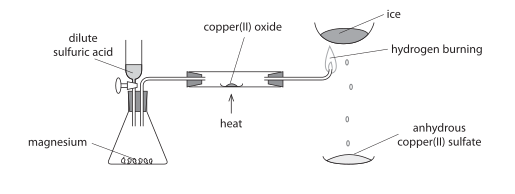
Complete the word equations for the reactions that occur.
magnesium + sulfuric acid → +
copper(II) oxide + hydrogen → +
anhydrous copper(II) sulfate + →
Final answer
- magnesium + sulfuric acid → magnesium sulfate + hydrogen
- copper(II) oxide + hydrogen → copper + water
- anhydrous copper(II) sulfate + water → hydrated copper(II) sulfate
Mark scheme points
- M1 magnesium sulfate and hydrogen
- M2 copper and water
- M3 water and hydrated copper(II) sulfate
Explanation
- A metal reacting with an acid makes a salt + hydrogen. With magnesium and sulfuric acid, the salt formed is magnesium sulfate.
- Hydrogen removes oxygen from copper(II) oxide, so copper(II) oxide is reduced to copper, and the oxygen combines with hydrogen to form water.
- Anhydrous copper(II) sulfate is used to test for water. When water is added, it becomes hydrated copper(II) sulfate.
For full marks, make sure each missing word is completed with the correct substance name. The products can be written in either order.
Common mistakes
- Writing copper sulfate instead of magnesium sulfate in the first equation.
- Forgetting that hydrogen reduces copper(II) oxide to copper, not to another copper compound.
- Missing water in the second or third equation.
- Writing the last product as just copper sulfate instead of hydrated copper(II) sulfate.
- Using the wrong oxidation number for copper in the last equation; copper(II) is required.
Question 2
A student uses this apparatus to find the mass of magnesium oxide that forms
when a known mass of magnesium is heated.
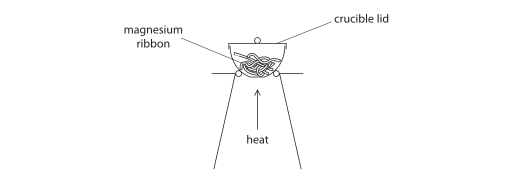
This is his method.
• find the mass of the crucible and lid
• place some magnesium ribbon in the crucible
• find the mass of the crucible, lid and magnesium
• heat the crucible with the lid on for a few minutes
• find the mass of the crucible, lid and magnesium oxide
Using this method, the mass of magnesium oxide formed is less than expected.
Explain two changes that the student should make to his method to obtain a
mass of magnesium oxide closer to the expected mass.
1
2
Final answer
- Lift and replace the lid during heating so that oxygen / air can enter the crucible and react with the magnesium.
- Reheat and reweigh until a constant mass is obtained, to make sure all the magnesium has reacted to form magnesium oxide, MgO.
Mark scheme points
- M1 Lift and replace the lid.
- M2 So oxygen / air can enter the crucible to react with the magnesium.
- M3 Reheat and reweigh / heat to constant mass.
- M4 To make sure all the magnesium has reacted.
Explanation
The low mass happens because the magnesium may not react fully with oxygen.
- If the lid stays on all the time, too little oxygen gets into the crucible. Briefly lifting and replacing the lid lets oxygen in so more magnesium can be oxidised.
- Then the crucible should be heated again and weighed again, repeating this until the mass stops changing. A constant mass shows the reaction is complete and all the magnesium has formed magnesium oxide.
To gain full marks, each change must be linked to the correct reason.
Common mistakes
- Saying only “heat it longer” is not enough; the key marking point is reheat and reweigh until constant mass.
- Removing the lid completely is not the best answer; the required idea is to lift and replace the lid.
- Giving the change without the reason can lose marks, for example saying “lift the lid” but not mentioning oxygen entering.
- Talking about adding more magnesium does not fix the problem; the issue is incomplete reaction with oxygen.
Practise This Subtopic
Build a focused practice set on chemical formulae, equations and calculations, with questions selected from this part of the Edexcel IGCSE Chemistry specification.