Edexcel IGCSE Chemistry States of matter questions

Revise the key specification points for States of matter, then try focused exam-style questions with worked explanations.

Edexcel IGCSE Chemistry Subtopic 1.a

What You Need To Know

States of matter questions can test recall, explanation, calculations, practical method, or data handling. For this subtopic, you should be able to:

  • 1.1 understand the three states of matter in terms of the arrangement, movement and energy of the particles
  • 1.2 understand the interconversions between the three states of matter in terms of: the names of the interconversions how they are achieved the changes in arrangement, movement and energy of the particles.
  • 1.3 understand how the results of experiments involving the dilution of coloured solutions and diffusion of gases can be explained
  • 1.4 know what is meant by the terms: solvent solute solution saturated solution.
  • 1.5C know what is meant by the term solubility in the units g per 100 g of solvent
  • 1.6C understand how to plot and interpret solubility curves
  • 1.7C practical: investigate the solubility of a solid in water at a specific temperature

How To Answer States of matter Questions

  1. Start by identifying exactly which specification point the question is testing.
  2. Use the command word carefully: state and identify need a direct answer, while describe and explain need linked detail.
  3. For tables, graphs, diagrams, and practical questions, quote the relevant observation or reading before drawing a conclusion.
  4. When a question asks for a calculation, show the key substitution and include units where they are needed.

Example Questions With Worked Explanations

Example 1: Core Knowledge

Question 1

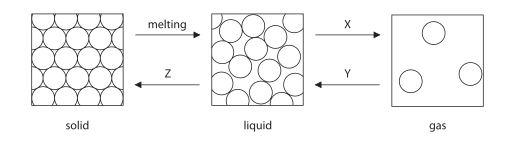
The diagram shows how the particles are arranged in the three states of matter. Diagram of particle arrangements in the three states of matter: solid (particles closely packed in a regular arrangement), liquid (particles close together but irregular), gas (particles far apart). An arrow labelled 'melting' points from solid to liquid. There is an arrow labelled 'X' from liquid to gas, an arrow labelled 'Y' from gas to liquid, and an arrow labelled 'Z' from liquid to solid. Use words from the box to identify the changes of state X, Y and Z.
condensing   cooling   crystallising   diffusing
evaporating   freezing   heating
X
Y
Z

Final answer

  • X: evaporating
  • Y: condensing
  • Z: freezing

Mark scheme points

  1. M1 X = evaporating
  2. M2 Y = condensing
  3. M3 Z = freezing

Explanation

  • X goes from liquid to gas, so the change of state is evaporating.
  • Y goes from gas to liquid, so the change of state is condensing.
  • Z goes from liquid to solid, so the change of state is freezing.

To get full marks, match the direction of the arrow to the state change. The question asks for the name of the change of state, not what causes it.

  • Heating can cause evaporation, but heating is not the name of the state change.
  • Cooling can cause condensation or freezing, but cooling is not the name of the state change.

Common mistakes

  • Writing heating or cooling instead of the actual change of state.
  • Mixing up evaporating and condensing by not checking the arrow direction.
  • Choosing crystallising for liquid to solid here; the required answer is freezing.
  • Not matching each label exactly: X is liquid to gas, Y is gas to liquid, Z is liquid to solid.
Example 2: Using Data and Practical Skills

Question 2

A student does an experiment to investigate how the temperature changes as different masses of solid potassium nitrate are dissolved in water.
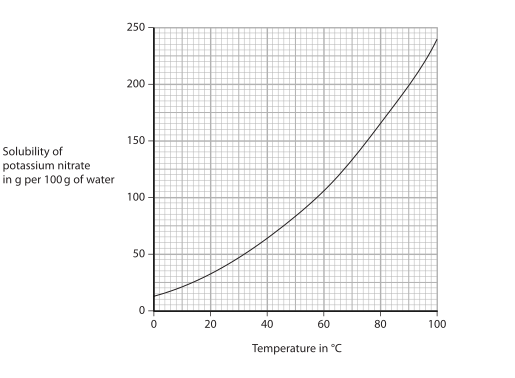
She looks at this graph to help her decide the masses of water and potassium nitrate to use in her experiment. Graph titled 'Solubility of potassium nitrate in g per 100g of water' against 'Temperature in °C' with a curve increasing as temperature increases. The student prepares six samples of potassium nitrate, each with a mass of 2.0 g.
She pours 50 cm3 of water into a 100 cm3 beaker and records the temperature of the water.
She then uses this method to find the change in temperature as she adds each sample of potassium nitrate.
● add the first sample of potassium nitrate to the beaker and stir until the sample dissolves
● record the temperature of the solution
● add the second sample of potassium nitrate to the solution in the beaker and stir until the sample dissolves
● record the new temperature of the solution
● repeat until all six samples of potassium nitrate have been added
The table shows her results.
Mass of potassium nitrate added in g 0.0 2.0 4.0 6.0 8.0 10.0 12.0
Temperature in °C 25.2 22.2 19.4 16.9 14.1 11.4 8.8
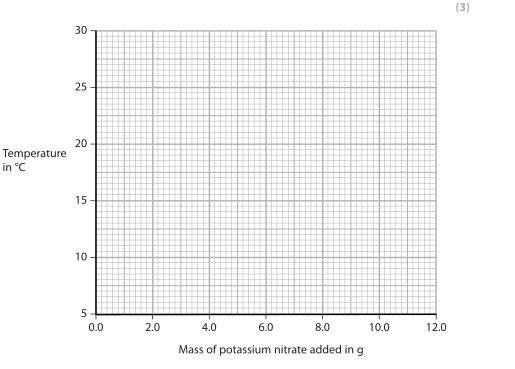
Plot the student’s results on the grid.
Draw a straight line of best fit.
Blank grid for plotting Temperature in °C (y-axis, 5 to 30) against Mass of potassium nitrate added in g (x-axis, 0.0 to 12.0).

Final answer

Plotted points with a straight line of best fit:

0.0 2.0 4.0 6.0 8.0 10.0 12.0 5 10 15 20 25 30 Mass of potassium nitrate added in g Temperature in °C

Mark scheme points

  1. M1 Plot the results correctly to the nearest gridline.
  2. M2 All points must be correct; each plotting error loses one mark.
  3. M3 Draw a straight line of best fit.

Explanation

To score full marks, plot all seven coordinate points accurately and then add one straight best-fit line.

  • M1 Plot the points at: (0.0, 25.2), (2.0, 22.2), (4.0, 19.4), (6.0, 16.9), (8.0, 14.1), (10.0, 11.4), (12.0, 8.8).
  • M2 Put each point on the nearest gridline. Small cross marks are best, so the examiner can see the exact position clearly.
  • M3 Use a ruler to draw a single straight line of best fit through the overall trend. Do not join point-to-point with separate line segments.

Your line should pass through the middle of the plotted pattern, with the points spread as evenly as possible around it.

Common mistakes

  • Missing the first point at 0.0 g and 25.2 °C.
  • Swapping the axes, so mass and temperature are plotted the wrong way round.
  • Rounding temperatures too much, for example plotting 8.8 °C at 9 or 11.4 °C at 11.
  • Joining the points dot-to-dot instead of drawing one straight line of best fit.
  • Drawing a best-fit line that ignores the overall trend or does not use a ruler.

Practise This Subtopic

Build a focused practice set on states of matter, with questions selected from this part of the Edexcel IGCSE Chemistry specification.