Example 1: Core Knowledge
Question 1
Potassium oxide (K2O) is an ionic compound.
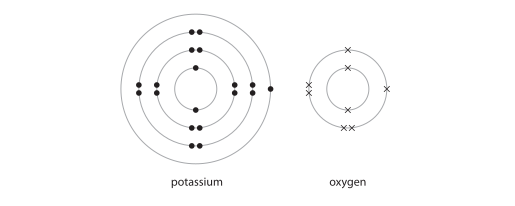
Draw the electronic configuration of a potassium ion and an oxide ion.
Show the charge on each ion.
Revise the key specification points for Ionic bonding, then try focused exam-style questions with worked explanations.
Ionic bonding questions can test recall, explanation, calculations, practical method, or data handling. For this subtopic, you should be able to:
Question 1
See diagram.
K+ has electron arrangement 2,8,8 and O2− has 2,8.
Question 2
| Total volume of lead(II) nitrate solution added in cm3 | Electrical conductivity in arbitrary units |
|---|---|
| 0 | 10.00 |
| 10 | 9.80 |
| 20 | 9.77 |
| 30 | 9.40 |
| 40 | 9.20 |
| 50 | 9.00 |
The electrical conductivity decreases as more lead(II) nitrate solution is added. This is because ions are removed from the solution when insoluble PbBr2 forms, so there are fewer mobile ions to carry charge.
To get full marks, make both ideas clear:
A concise full-mark answer is: “The conductivity decreases because PbBr2 precipitates, so ions are removed from the solution and there are fewer ions to conduct electricity.”
Build a focused practice set on ionic bonding, with questions selected from this part of the Edexcel IGCSE Chemistry specification.