Revise the key specification points for Covalent bonding, then try focused exam-style questions with worked explanations.
EdexcelIGCSEChemistrySubtopic 1.g
What You Need To Know
Covalent bonding questions can test recall, explanation, calculations, practical method, or data handling. For this subtopic, you should be able to:
1.44 know that a covalent bond is formed between atoms by the sharing of a pair of electrons
1.45 understand covalent bonds in terms of electrostatic attractions
1.46 understand how to use dot-and-cross diagrams to represent covalent bonds in: diatomic molecules, including hydrogen, oxygen, nitrogen, halogens and hydrogen halides inorganic molecules including water, ammonia and carbon dioxide organic molecules containing up to two carbon atoms, including methane, ethane, ethene and those containing halogen atoms.
1.47 explain why substances with a simple molecular structures are gases or liquids, or solids with low melting and boiling points the term intermolecular forces of attraction can be used to represent all forces between molecules
1.48 explain why the melting and boiling points of substances with simple molecular structures increase, in general, with increasing relative molecular mass
1.49 explain why substances with giant covalent structures are solids with high melting and boiling points
1.50 explain how the structures of diamond, graphite and C60 fullerene influence their physical properties, including electrical conductivity and hardness
How To Answer Covalent bonding Questions
Start by identifying exactly which specification point the question is testing.
Use the command word carefully: state and identify need a direct answer, while describe and explain need linked detail.
For tables, graphs, diagrams, and practical questions, quote the relevant observation or reading before drawing a conclusion.
When a question asks for a calculation, show the key substitution and include units where they are needed.
Example Questions With Worked Explanations
Example 1: Using Data and Practical Skills
Question 1
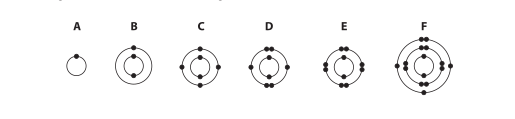
The diagram shows the electronic configurations of six different atoms.
You may use the Periodic Table on page 2 to help you answer this question.
Answer each part by writing one of the letters A, B, C, D, E or F in the box provided.
You may use each letter once, more than once or not at all.
Give the letter that represents an atom
(i) of a noble gas
(ii) that contains three protons
(iii) of phosphorus
(iv) of an element in Group 4 of the Periodic Table
(v) of an element in Period 3 of the Periodic Table
(vi) with a full outer shell of electrons
Final answer
(i) E
(ii) B
(iii) F
(iv) C
(v) F
(vi) E
Mark scheme points
M1 Noble gas: E
M2 Contains three protons: B
M3 Phosphorus: F
M4 Element in Group 4: C
M5 Element in Period 3: F
M6 Full outer shell of electrons: E
Explanation
Use two quick rules:
The group tells you the number of outer-shell electrons.
The period tells you the number of occupied shells.
(i) A noble gas has a full outer shell, so the correct letter is E.
(ii) In a neutral atom, number of protons = electrons. Three protons means atomic number 3, so the atom is B.
(iii) Phosphorus has electron arrangement 2,8,5, so it is F.
(iv) Group 4 elements have 4 electrons in the outer shell, so choose C.
(v) A Period 3 element has 3 occupied shells, so the answer is F.
(vi) An atom with a full outer shell is again E.
Notice that the same letter can be used more than once, so E is correct for both (i) and (vi), and F is correct for both (iii) and (v).
Common mistakes
Mixing up group and period: group = outer electrons, period = number of shells.
Forgetting that in a neutral atom, the number of electrons equals the number of protons.
Choosing a noble gas by total electrons instead of checking for a full outer shell.
Assuming each letter can only be used once. Here, some letters are used more than once.
Example 2: Using Data and Practical Skills
Question 2
A teacher discussed with her students whether the boiling points of organic compounds are related to the size of their molecules.
The students suggested measuring the boiling points of some organic compounds using this apparatus.
The students used the apparatus recommended by the teacher to measure the boiling points of five alcohols.
Their results are shown in the table.
Alcohol
A
B
C
D
E
Boiling point in °C
78
96
138
157
176
Relative formula mass
46
60
88
102
116
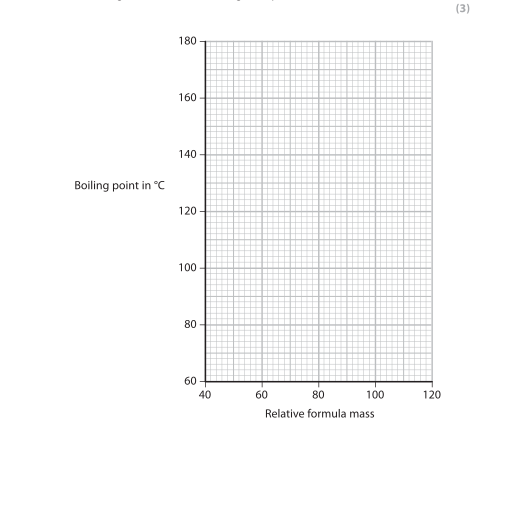
Plot a graph of the data in the table on the grid.
Draw a straight line of best fit through the points.
Final answer
See graph: all five points are plotted correctly, with a straight line of best fit.
Mark scheme points
M1 Plot the data points accurately on the grid.
M2 All five points must be correct to the nearest gridline.
M3 Draw a straight line of best fit with a ruler; it should pass through at least two correctly plotted points.
Explanation
To secure all 3 marks, make sure your graph matches the table exactly and shows the overall trend.
Plot these five coordinates: (46, 78), (60, 96), (88, 138), (102, 157) and (116, 176).
Each point must be placed to the nearest gridline. A small cross is best, because the exact position stays visible.
Use a ruler to draw one straight line of best fit through the pattern of points. It should follow the trend and pass through at least two correctly plotted points.
Do not join the points dot-to-dot, and the line does not need to be extended beyond the data.
Common mistakes
Swapping the axes and plotting boiling point on the x-axis.
Missing one of the five points or placing a point on the wrong square.
Drawing a freehand line instead of a straight ruler line.
Joining each point to the next instead of drawing one straight line of best fit.
Making points too large so the exact plotted position cannot be seen clearly.
Practise This Subtopic
Build a focused practice set on covalent bonding, with questions selected from this part of the Edexcel IGCSE Chemistry specification.