Edexcel IGCSE Chemistry Electrolysis questions

Revise the key specification points for Electrolysis, then try focused exam-style questions with worked explanations.

Edexcel IGCSE Chemistry Subtopic 1.i

What You Need To Know

Electrolysis questions can test recall, explanation, calculations, practical method, or data handling. For this subtopic, you should be able to:

  • 1.55C understand why covalent compounds do not conduct electricity
  • 1.56C understand why ionic compounds conduct electricity only when molten or in aqueous solution
  • 1.57C know that anion and cation are terms used to refer to negative and positive ions respectively
  • 1.58C describe experiments to investigate electrolysis, using inert electrodes, of molten compounds (including lead(II) bromide) and aqueous solutions (including sodium chloride, dilute sulfuric acid and copper(II) sulfate) and to predict the products
  • 1.59C write ionic half-equations representing the reactions at the electrodes during electrolysis and understand why these reactions are classified as oxidation or reduction
  • 1.60C practical: investigate the electrolysis of aqueous solutions

How To Answer Electrolysis Questions

  1. Start by identifying exactly which specification point the question is testing.
  2. Use the command word carefully: state and identify need a direct answer, while describe and explain need linked detail.
  3. For tables, graphs, diagrams, and practical questions, quote the relevant observation or reading before drawing a conclusion.
  4. When a question asks for a calculation, show the key substitution and include units where they are needed.

Example Questions With Worked Explanations

Example 1: Core Knowledge

Question 1

When copper(II) sulfate solution is electrolysed, copper forms at the negative electrode.
A student uses this apparatus to investigate the electrolysis of copper(II) sulfate solution.
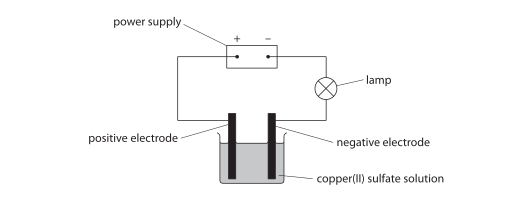
Circuit diagram showing a power supply connected to two electrodes in copper(II) sulfate solution, with a lamp in series; electrodes are labelled positive and negative. Oxygen forms at the positive electrode. Complete the half-equation for the formation of oxygen at the positive electrode.
2H2O → + +

Final answer

2H2O → 4H+ + O2 + 4e

Mark scheme points

  1. M1 Includes O2 and e on the product side.
  2. M2 Full half-equation correct: 2H2O → 4H+ + O2 + 4e.

Explanation

At the positive electrode, water is oxidised to oxygen.

  • First, make sure the products include oxygen gas, O2, and electrons, e. That secures the first marking point.
  • Then balance the equation fully. Starting from 2H2O gives 4 hydrogen atoms and 2 oxygen atoms on the left.
  • Put O2 on the right for the 2 oxygen atoms, and 4H+ for the 4 hydrogen atoms.
  • Now balance charge: the right side has +4 from 4H+, so add 4e to make the total charge 0 on both sides.

This gives the complete balanced half-equation:

2H2O → 4H+ + O2 + 4e

Common mistakes

  • Examiners reported that this was poorly answered: only a small minority gained both marks. A very common error was writing 2H2 instead of 4H+, which may balance atoms but does not balance charge.
  • Writing O instead of O2. Oxygen is diatomic.
  • Forgetting the electrons, or putting them on the left-hand side.
  • Balancing atoms but not balancing charge. Half-equations must balance both.
  • Using 4OH → 2H2O + O2 + 4e does not complete the given equation and only gains partial credit here.
Example 2: Using Data and Practical Skills

Question 2

Solid calcium chloride does not conduct electricity. Aqueous solutions of calcium chloride do conduct electricity.
A student uses this method to investigate how the conductivity of a solution changes when calcium chloride is dissolved in pure water.
Step 1 add 100 cm3 of pure water to a beaker
Step 2 add one spatula of solid calcium chloride to the beaker
Step 3 stir the solution
Step 4 measure the conductivity of the solution
Step 5 repeat until nine spatulas of solid calcium chloride have been added
The table shows the student’s results.
Number of spatulas of calcium chloride Conductivity of solution in arbitrary units
00
16
212
312
424
530
636
736
836
936
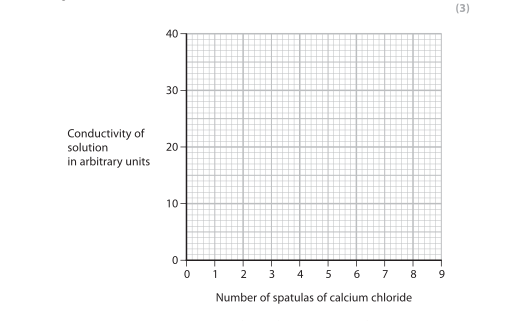
Plot the results on the grid and draw two straight lines of best fit.
Ignore the anomalous result. Blank plotting grid for conductivity (arbitrary units) against number of spatulas of calcium chloride (0 to 9), with y-axis up to 40; intended for plotting and drawing two straight lines of best fit.

Final answer

See graph. The anomalous point at (3, 12) is plotted, but the two straight lines of best fit ignore it.

0 1 2 3 4 5 6 7 8 9 0 10 20 30 40 Number of spatulas of calcium chloride Conductivity of solution in arbitrary units

Mark scheme points

  1. M1 Plot the points accurately; one plotting error can still score this mark.
  2. M2 All points plotted correctly to within ± half a square.
  3. M3 Draw two straight lines of best fit, ignoring the anomalous point.

Explanation

To get full marks, plot all the results from the table, including the anomalous result. The anomaly is the point at 3 spatulas, conductivity 12. You still plot it, but you do not use it when drawing the best-fit lines.

  • Plot the coordinates accurately to within ± half a square: (0,0), (1,6), (2,12), (3,12), (4,24), (5,30), (6,36), (7,36), (8,36), (9,36).
  • The first best-fit line should be a straight rising line from about (0,0) to about (6,36).
  • The second best-fit line should be a straight horizontal line at 36 from about 6 to 9 spatulas.
  • Do not force either line through the anomalous point at (3,12).

Common mistakes

  • Leaving out the anomalous point completely. It should be plotted, just not used for the best-fit lines.
  • Joining the points dot-to-dot instead of drawing two straight lines of best fit.
  • Drawing one bent line or a curve instead of two separate straight lines.
  • Making the rising line pass through the anomalous point at (3,12).
  • Plotting points more than half a square away from their correct positions.

Practise This Subtopic

Build a focused practice set on electrolysis, with questions selected from this part of the Edexcel IGCSE Chemistry specification.