Edexcel IGCSE Chemistry Reactivity series questions

Revise the key specification points for Reactivity series, then try focused exam-style questions with worked explanations.

Edexcel IGCSE Chemistry Subtopic 2.d

What You Need To Know

Reactivity series questions can test recall, explanation, calculations, practical method, or data handling. For this subtopic, you should be able to:

  • 2.15 understand how metals can be arranged in a reactivity series based on their reactions with: water dilute hydrochloric or sulfuric acid.
  • 2.16 understand how metals can be arranged in a reactivity series based on their displacement reactions between: metals and metal oxides metals and aqueous solutions of metal salts.
  • 2.17 know the order of reactivity of these metals: potassium, sodium, lithium, calcium, magnesium, aluminium, zinc, iron, copper, silver, gold
  • 2.18 know the conditions under which iron rusts
  • 2.19 understand how the rusting of iron may be prevented by: barrier methods galvanising sacrificial protection.
  • 2.20 understand the terms: oxidation reduction redox oxidising agent reducing agent in terms of gain or loss of oxygen and loss or gain of electrons.
  • 2.21 practical: investigate reactions between dilute hydrochloric and sulfuric acids and metals (e.g. magnesium, zinc and iron)

How To Answer Reactivity series Questions

  1. Start by identifying exactly which specification point the question is testing.
  2. Use the command word carefully: state and identify need a direct answer, while describe and explain need linked detail.
  3. For tables, graphs, diagrams, and practical questions, quote the relevant observation or reading before drawing a conclusion.
  4. When a question asks for a calculation, show the key substitution and include units where they are needed.

Example Questions With Worked Explanations

Example 1: Core Knowledge

Question 1

The diagram shows two samples of iron, A and B. Diagram of two rectangular samples labelled A and B. Sample A is iron. Sample B is iron coated with a thin outer layer labelled zinc. Sample B is coated with a thin layer of zinc. The two samples of iron are left outside for several weeks.
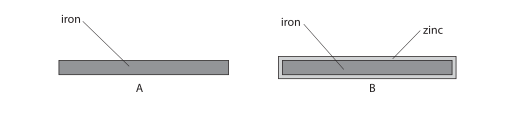
A brown solid containing hydrated iron(III) oxide forms on sample A. Give the names of the two substances that react with the iron to form the brown solid.
1
2

Final answer

  • oxygen (or air)
  • water (or moisture)

Mark scheme points

  1. M1 oxygen / air
  2. M2 water

Explanation

The brown solid is rust, which forms when iron reacts with oxygen and water.

  • For the first mark, write oxygen. Air is also acceptable because it contains oxygen.
  • For the second mark, write water. Moisture or H2O would also be accepted.

To get full marks, name both substances.

Common mistakes

  • Giving only one substance, such as just oxygen.
  • Writing hydrogen instead of water.
  • Naming zinc as one of the reactants, even though the question asks what reacts with the iron to form rust.
  • Forgetting that rusting needs both oxygen and water.

Example 2: Explaining the Chemistry

Question 2

A student investigates the rusting of iron. The student then sets up two more test tubes containing iron nails. Diagram showing two test tubes each containing an iron nail. Tube 1 contains boiled water with a layer of oil on top. Tube 2 contains air with a drying agent above the nail. Explain why the iron nail in tube 1 and the iron nail in tube 2 do not rust.
tube 1


tube 2


Final answer

tube 1
Oxygen is needed for rusting. The water was boiled, so it does not contain dissolved air/oxygen, and the oil layer stops air/oxygen from getting back in.

tube 2
Water/moisture is needed for rusting. The drying agent removes water/moisture from the air, so the nail does not rust.

Mark scheme points

  1. M1 Air/oxygen is needed for rusting.
  2. M2 Boiled water does not contain air/oxygen.
  3. M3 The oil keeps air/oxygen out.
  4. M4 Water/moisture is needed for rusting.
  5. M5 The drying agent keeps water/moisture out.

Explanation

To get full marks, explain each tube by linking the missing condition to rusting.

  • Tube 1: Rusting needs oxygen. Boiling the water removes dissolved air/oxygen, and the oil layer prevents oxygen from the air entering the water again.
  • Tube 2: Rusting also needs water/moisture. The drying agent absorbs water vapour, so the air in the tube is dry and the nail has no moisture around it.

A strong exam answer states both what is needed for rusting and why that condition is absent in each tube.

Common mistakes

  • Only saying what is in the tube, without linking it to the condition needed for rusting.
  • For tube 1, saying only “there is oil” instead of explaining that the oil keeps oxygen/air out.
  • For tube 2, talking about lack of oxygen instead of lack of water/moisture.
  • Forgetting that rusting needs both oxygen and water.

Practise This Subtopic

Build a focused practice set on reactivity series, with questions selected from this part of the Edexcel IGCSE Chemistry specification.