Edexcel IGCSE Chemistry Group 7 (halogens) – chlorine, bromine and iodine questions

Revise the key specification points for Group 7 (halogens) – chlorine, bromine and iodine, then try focused exam-style questions with worked explanations.

Edexcel IGCSE Chemistry Subtopic 2.b

What You Need To Know

Group 7 (halogens) – chlorine, bromine and iodine questions can test recall, explanation, calculations, practical method, or data handling. For this subtopic, you should be able to:

  • 2.5 know the colours, physical states (at room temperature) and trends in physical properties of these elements
  • 2.6 use knowledge of trends in Group 7 to predict the properties of other halogens
  • 2.7 understand how displacement reactions involving halogens and halides provide evidence for the trend in reactivity in Group 7
  • 2.8C explain the trend in reactivity in Group 7 in terms of electronic configurations

How To Answer Group 7 (halogens) – chlorine, bromine and iodine Questions

  1. Start by identifying exactly which specification point the question is testing.
  2. Use the command word carefully: state and identify need a direct answer, while describe and explain need linked detail.
  3. For tables, graphs, diagrams, and practical questions, quote the relevant observation or reading before drawing a conclusion.
  4. When a question asks for a calculation, show the key substitution and include units where they are needed.

Example Questions With Worked Explanations

Example 1: Core Knowledge

Question 1

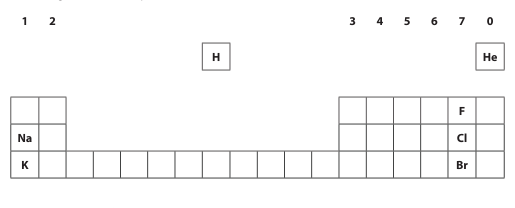
The diagram shows the positions of some elements in the Periodic Table. Partial Periodic Table diagram with group numbers 1, 2, 3, 4, 5, 6, 7, 0. Elements shown include H, He, F, Cl, Br, Na, K positioned in their groups. When chlorine gas is bubbled through an aqueous solution of sodium bromide, a displacement reaction takes place.
The ionic equation for the reaction is:
Cl2(g) + 2Br(aq) → 2Cl(aq) + Br2(aq)
State the colour change that you would observe in the solution during this reaction.
Colour at start
Colour at end

Final answer

  • Colour at start: colourless
  • Colour at end: orange / yellow / brown

Mark scheme points

  1. M1 Colour at start is colourless.
  2. M2 Colour at end is orange, yellow or brown.

Explanation

At the start, the solution contains sodium bromide(aq). Bromide ions in aqueous solution are colourless, so this is the first scoring point.

When chlorine is bubbled through, it displaces bromine from bromide ions:

Cl2 + 2Br → 2Cl + Br2

The bromine formed in solution gives an orange, yellow or brown colour, so any one of these gets the second mark.

  • Start: write colourless.
  • End: write orange, yellow or brown.

Common mistakes

  • Writing no colour instead of colourless for the starting solution.
  • Saying the solution becomes decolourised; it actually gains colour because bromine is formed.
  • Giving the colour of chlorine gas instead of the colour of the solution after reaction.
  • Using a final colour outside the accepted range; the mark scheme allows orange, yellow or brown.
Example 2: Using Data and Practical Skills

Question 2

Bromine, chlorine and iodine are halogens in Group 7 of the Periodic Table.
The three halogens have similar chemical properties but different reactivities.
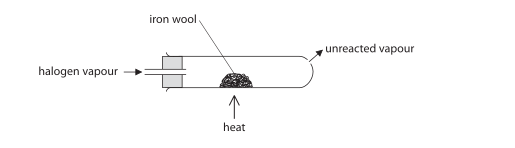
A teacher uses this apparatus to demonstrate the difference in reactivity between these halogens.
Apparatus: halogen vapour flows through a horizontal tube containing iron wool; heat is applied beneath the iron wool; unreacted vapour exits the tube.
The teacher does each experiment in a fume cupboard.
The table shows the observation for each halogen.
Halogen Observation
bromine the iron wool glows brightly
chlorine the iron wool glows very brightly
iodine the iron wool glows dimly
Use the information in the table to explain the order of reactivity of the three halogens.

Final answer

Chlorine is the most reactive, bromine is less reactive, and iodine is the least reactive:

chlorine > bromine > iodine

This is because the iron wool glows very brightly with chlorine, brightly with bromine, and only dimly with iodine.

Mark scheme points

  1. M1 Correct order of reactivity: chlorine > bromine > iodine, or chlorine most reactive and iodine least reactive.
  2. M2 Uses the observations as evidence: chlorine makes the iron wool glow most brightly / very brightly, and iodine makes it glow least brightly / dimly.

Explanation

To get full marks, give both the order and the evidence from the table.

  • The brightest glow shows the most vigorous reaction, so chlorine is the most reactive.
  • The dimmest glow shows the least vigorous reaction, so iodine is the least reactive.
  • Bromine is in between, so the full order is chlorine > bromine > iodine.

A strong exam answer links the reactivity directly to the observations, not just to Group 7 trends.

Common mistakes

  • Writing only “reactivity decreases down the group” without using the table evidence.
  • Giving the order incorrectly, for example putting bromine above chlorine.
  • Not stating that iodine is the least reactive.
  • Talking about heat given out instead of using the glow observations.

Practise This Subtopic

Build a focused practice set on group 7 (halogens) – chlorine, bromine and iodine, with questions selected from this part of the Edexcel IGCSE Chemistry specification.