Edexcel IGCSE Chemistry Gases in the atmosphere questions

Revise the key specification points for Gases in the atmosphere, then try focused exam-style questions with worked explanations.

Edexcel IGCSE Chemistry Subtopic 2.c

What You Need To Know

Gases in the atmosphere questions can test recall, explanation, calculations, practical method, or data handling. For this subtopic, you should be able to:

  • 2.9 know the approximate percentages by volume of the four most abundant gases in dry air
  • 2.10 understand how to determine the percentage by volume of oxygen in air using experiments involving the reactions of metals (e.g. iron) and non-metals (e.g. phosphorus) with air
  • 2.11 describe the combustion of elements in oxygen, including magnesium, hydrogen and sulfur
  • 2.12 describe the formation of carbon dioxide from the thermal decomposition of metal carbonates, including copper(II) carbonate
  • 2.13 know that carbon dioxide is a greenhouse gas and that increasing amounts in the atmosphere may contribute to climate change
  • 2.14 practical: determine the approximate percentage by volume of oxygen in air using a metal or a non-metal

How To Answer Gases in the atmosphere Questions

  1. Start by identifying exactly which specification point the question is testing.
  2. Use the command word carefully: state and identify need a direct answer, while describe and explain need linked detail.
  3. For tables, graphs, diagrams, and practical questions, quote the relevant observation or reading before drawing a conclusion.
  4. When a question asks for a calculation, show the key substitution and include units where they are needed.

Example Questions With Worked Explanations

Example 1: Core Knowledge

Question 1

A student uses this apparatus to investigate the effect of heat on different solid metal carbonates. Apparatus diagram: a boiling tube containing metal carbonate is heated; a delivery tube carries gas into a test tube containing limewater. This is the student’s method.
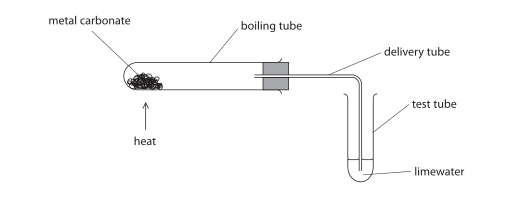
  • use a spatula to put some metal carbonate in the boiling tube
  • fit the delivery tube into position
  • pour some limewater into the test tube
  • start a timer and immediately begin to heat the metal carbonate
  • record the time when a change first occurs in the limewater
The student repeats the method using different metal carbonates.
When a metal carbonate is heated a reaction sometimes occurs.
The equation for the reaction is
metal carbonate → metal oxide + carbon dioxide The table shows some of the results for the student’s investigation.
Metal carbonate Colour change of solid Time taken for any change in limewater
calcium carbonate remains white 90 seconds
sodium carbonate remains white no change
copper(II) carbonate 50 seconds
State the colour change that occurs for copper(II) carbonate.
from to

Final answer

green to black

Mark scheme points

  1. M1 from green
  2. M2 to black

Explanation

To get both marks, state the starting colour and the final colour of copper(II) carbonate when heated:

  • It starts green.
  • After heating, it becomes black.

This is because copper(II) carbonate thermally decomposes to copper(II) oxide, which is black, and carbon dioxide.

Write the answer exactly as a colour change: green to black.

Common mistakes

  • Reversing the colours. The change is from green to black, not black to green.
  • Giving only one colour. You need both the starting and ending colours for full marks.
  • Describing the limewater instead of the solid. The question asks for the colour change of copper(II) carbonate.
  • Using the wrong starting colour, such as blue. Copper(II) carbonate is green.
Example 2: Using Data and Practical Skills

Question 2

This question is about metal carbonates.

When heated, some metal carbonates decompose to form a metal oxide and carbon dioxide gas.

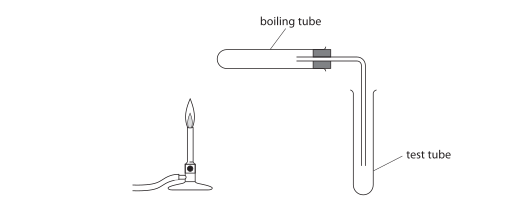
A student is given three solid metal carbonates, a timer, some limewater and this apparatus.

Apparatus diagram: a boiling tube is heated with a Bunsen burner and connected by a delivery tube into a test tube (for limewater) to test for carbon dioxide.

Describe a method the student can use to find out which metal carbonate decomposes fastest when heated.

Final answer

  • Put one of the metal carbonates in the boiling tube and put limewater in the test tube.
  • Heat the carbonate and start the timer. Measure how long it takes for the limewater to turn cloudy.
  • Repeat with the other metal carbonates, using the same mass (or amount / number of moles) of carbonate each time and the same volume of fresh limewater.
  • The metal carbonate that turns the limewater cloudy in the shortest time is the one that decomposes fastest.

Mark scheme points

  1. M1 Put the carbonate in the boiling tube and the limewater in the test tube.
  2. M2 Heat the carbonate and time how long it takes for the limewater to turn cloudy.
  3. M3 Repeat with another carbonate using the same mass / amount / number of moles of carbonate each time.
  4. M4 The carbonate that decomposes fastest is the one that turns the limewater cloudy in the least time.

Explanation

To get full marks, describe the method in the same order as the apparatus works.

  • First, the metal carbonate is heated in the boiling tube. The limewater must be in the separate test tube so the gas produced can be tested.
  • When the carbonate decomposes, it produces carbon dioxide. This passes into the limewater, which turns cloudy. So the measurement is the time taken for the limewater to turn cloudy.
  • For the fair test mark, you must say that each carbonate is tested using the same mass (or amount / moles). Using the same volume of fresh limewater also keeps the comparison fair.
  • Finally, identify the result correctly: the shortest time means the fastest decomposition.

A short, clear method like this scores better than a vague description.

Common mistakes

  • Putting the metal carbonate and the limewater in the same tube. They must be in separate tubes.
  • Saying to count bubbles instead of timing how long it takes for the limewater to turn cloudy.
  • Forgetting the fair test point: use the same mass / amount of each carbonate each time.
  • Not stating how to decide the answer. The fastest carbonate is the one that makes the limewater turn cloudy in the least time.
  • Examiners reported that many candidates reached 3 marks here, but only the best answers gained the fair-test mark by clearly stating that the same mass of metal carbonate should be used each time.

Practise This Subtopic

Build a focused practice set on gases in the atmosphere, with questions selected from this part of the Edexcel IGCSE Chemistry specification.