Edexcel IGCSE Chemistry Acids, alkalis and titrations questions
Revise the key specification points for Acids, alkalis and titrations, then try focused exam-style questions with worked explanations.
EdexcelIGCSEChemistrySubtopic 2.f
What You Need To Know
Acids, alkalis and titrations questions can test recall, explanation, calculations, practical method, or data handling. For this subtopic, you should be able to:
2.28 describe the use of litmus, phenolphthalein and methyl orange to distinguish between acidic and alkaline solutions
2.29 understand how to use the pH scale, from 0–14, can be used to classify solutions as strongly acidic (0–3), weakly acidic (4–6), neutral (7), weakly alkaline (8–10) and strongly alkaline (11–14)
2.30 describe the use of universal indicator to measure the approximate pH value of an aqueous solution
2.31 know that acids in aqueous solution are a source of hydrogen ions and alkalis in a aqueous solution are a source of hydroxide ions
2.32 know that alkalis can neutralise acids
2.33C describe how to carry out an acid-alkali titration
How To Answer Acids, alkalis and titrations Questions
Start by identifying exactly which specification point the question is testing.
Use the command word carefully: state and identify need a direct answer, while describe and explain need linked detail.
For tables, graphs, diagrams, and practical questions, quote the relevant observation or reading before drawing a conclusion.
When a question asks for a calculation, show the key substitution and include units where they are needed.
Example Questions With Worked Explanations
Example 1: Using Data and Practical Skills
Question 1
A student does a titration to find the concentration of a solution of dilute sulfuric acid.
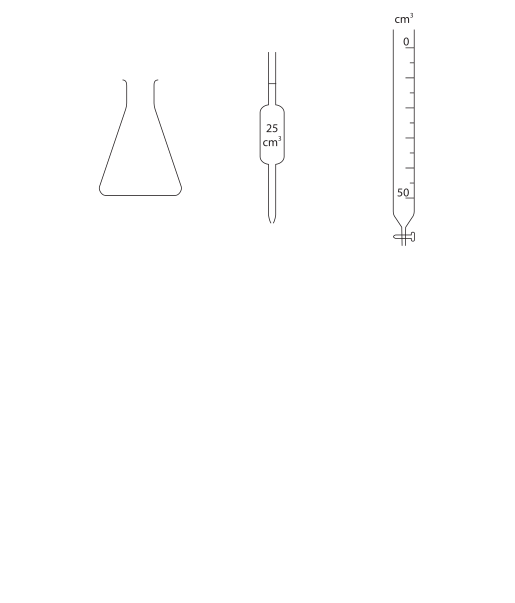
The student uses these solutions and this apparatus.
dilute sulfuric acid
potassium hydroxide solution of concentration 0.240mol/dm3
methyl orange indicator
(a) The student wants to find the volume of sulfuric acid needed to neutralise 25.0cm3 of the potassium hydroxide solution.
Describe how the student should do this titration.
Assume that all pieces of apparatus are clean and dry.
Final answer
Use the pipette to transfer 25.0 cm3 of potassium hydroxide solution into a conical flask.
Add a few drops of methyl orange to the flask.
Fill the burette with dilute sulfuric acid and record the initial burette reading.
Run the sulfuric acid from the burette into the flask while swirling the flask continuously.
Stop when the indicator changes to orange / red.
Record the final burette reading and calculate the volume of sulfuric acid added from the difference between the two readings.
Repeat the titration, adding the acid dropwise near the end-point, until concordant results are obtained.
Mark scheme points
M1 Use the pipette to add 25 cm3 of potassium hydroxide solution to the conical flask.
M2 Add a few drops of methyl orange to the flask.
M3 Add sulfuric acid to the burette and record the initial burette reading.
M4 Add sulfuric acid from the burette to the flask, swirling continuously.
M5 Continue until the methyl orange turns red / orange.
M6 Record the final burette reading and find the volume of acid added by subtracting the initial reading from the final reading.
M7 Repeat the titration, adding acid dropwise near the end-point, to obtain concordant results.
Explanation
To score full marks, describe the method in the correct order and name which solution goes in each piece of apparatus.
Measure exactly 25.0 cm3 of potassium hydroxide with the pipette and put it in the conical flask.
Add a few drops of methyl orange to the alkali in the flask.
Put the sulfuric acid in the burette and record the initial burette reading.
Run the acid into the flask while swirling so the solutions mix properly.
The end-point is when methyl orange changes to orange / red.
Read the burette again at the end and work out the acid volume used from the difference.
volume of sulfuric acid used
= final burette reading − initial burette reading
Repeat the titration and add the acid dropwise near the end-point so you can get concordant results.
Common mistakes
Putting the sulfuric acid in the flask and the potassium hydroxide in the burette.
Forgetting to mention methyl orange or not stating that only a few drops are added.
Not recording the initial and final burette readings, so the volume used cannot be calculated.
Giving the wrong end-point colour for methyl orange.
Not mentioning that the titration should be repeated and the acid added dropwise near the end-point.
Example 2: Using Data and Practical Skills
Question 2
A student investigates the reaction of aqueous sodium hydroxide with two different aqueous solutions of hydrochloric acid, solution X and solution Y.
She carries out two experiments.
Experiment 1
x Using a measuring cylinder, she pours 20 cm3 of aqueous sodium hydroxide into a conical flask and records its temperature.
x Using a burette, she adds 5 cm3 of solution X to the conical flask.
x She stirs the mixture with the thermometer and records the temperature.
x She adds further 5 cm3 volumes of solution X and stirs with the thermometer.
x She records the temperature after each addition of solution X.
x She stops when a total of 40 cm3 of solution X has been added.
Experiment 2
x She empties the burette and rinses it first with water and then with solution Y. She then fills the burette with solution Y.
x She repeats the experiment using solution Y.
The table shows the results she obtains in Experiment 1.
Experiment 1 – Solution X
Volume in cm3 of solution X added
Temperature in °C
0
23.0
5
27.0
10
31.0
15
32.2
20
30.6
25
28.9
30
27.3
35
25.6
40
24.0
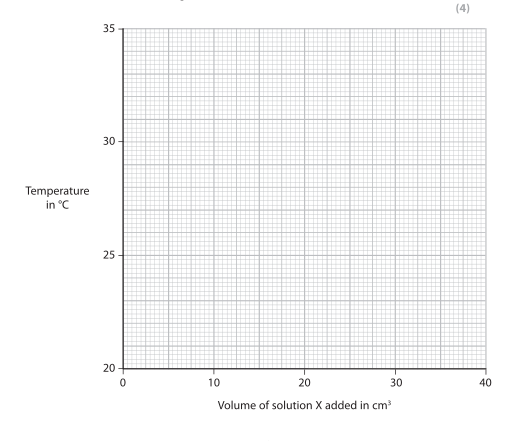
Plot the results for Experiment 1 on the grid.
Draw a straight line of best fit through the first three points and a second straight line of best fit through the last six points.
Make sure that the two straight lines cross.
Final answer
See diagram.
Mark scheme points
M1 Plot the points correctly.
M2 Plot them to the nearest gridline.
M3 Draw a straight line of best fit through the first three points using a ruler.
M4 Draw a straight line of best fit through the last six points using a ruler.
Explanation
First plot all nine data points accurately: (0, 23.0), (5, 27.0), (10, 31.0), (15, 32.2), (20, 30.6), (25, 28.9), (30, 27.3), (35, 25.6), (40, 24.0).
Use the grid carefully for the decimal temperatures. Values such as 32.2, 30.6 and 28.9 must be placed between the whole-number lines, not rounded.
Then use a ruler to draw one straight best-fit line through only the first three points: 0, 5 and 10 cm3.
Use a second straight best-fit line through the last six points: 15 to 40 cm3. Extend the lines so they cross clearly, at about 12.5 cm3 and 33 °C.
Common mistakes
Missing the starting point at 0 cm3, 23.0 °C.
Rounding 32.2, 30.6, 28.9, 27.3 or 25.6 to whole numbers when plotting.
Joining the points with a zig-zag line or a curve instead of drawing two separate straight best-fit lines.
Using the wrong points for each line: the first line is through the first three points only, and the second line is through the last six points.
Drawing freehand instead of with a ruler; each wrongly plotted point can cost a mark.
Practise This Subtopic
Build a focused practice set on acids, alkalis and titrations, with questions selected from this part of the Edexcel IGCSE Chemistry specification.