Edexcel IGCSE Chemistry Chemical tests questions

Revise the key specification points for Chemical tests, then try focused exam-style questions with worked explanations.

Edexcel IGCSE Chemistry Subtopic 2.h

What You Need To Know

Chemical tests questions can test recall, explanation, calculations, practical method, or data handling. For this subtopic, you should be able to:

  • 2.44 describe tests for these gases: hydrogen oxygen carbon dioxide ammonia chlorine.
  • 2.45 describe how to carry out a flame test
  • 2.46 know the colours formed in flame tests for these cations: Li+ is red Na+ is yellow K+ is lilac Ca2+ is orange-red Cu2+ is blue-green.
  • 2.47 describe tests for these cations: NH4+ using sodium hydroxide solution and identifying the gas evolved Cu2+, Fe2+ and Fe3+ using sodium hydroxide solution.
  • 2.48 describe tests for these anions: Cl–, Br– and I– using acidified silver nitrate solution SO42– using acidified barium chloride solution CO32– using hydrochloric acid and identifying the gas evolved.
  • 2.49 describe a test for the presence of water using anhydrous copper(II) sulfate
  • 2.50 describe a physical test to show whether a sample of water is pure

How To Answer Chemical tests Questions

  1. Start by identifying exactly which specification point the question is testing.
  2. Use the command word carefully: state and identify need a direct answer, while describe and explain need linked detail.
  3. For tables, graphs, diagrams, and practical questions, quote the relevant observation or reading before drawing a conclusion.
  4. When a question asks for a calculation, show the key substitution and include units where they are needed.

Example Questions With Worked Explanations

Example 1: Explaining the Chemistry

Question 1

A student uses this apparatus to find the heat energy change when ammonium nitrate dissolves in water to form a solution. Polystyrene cup containing distilled water with a thermometer and a stirring rod/spatula.

This is the student’s method.
  • add 50cm3 of distilled water to the polystyrene cup and record the initial temperature of the water
  • add a known mass of ammonium nitrate to the polystyrene cup and stir the mixture until all the solid dissolves
  • record the minimum temperature of the ammonium nitrate solution
Describe a test to show that the ammonium nitrate solution contains ammonium ions.


Final answer

  • Add sodium hydroxide solution to the ammonium nitrate solution and warm it. Test the gas evolved with damp red litmus paper. The red litmus turns blue.
  • Alternative: Add sodium hydroxide solution to the ammonium nitrate solution and warm it. Test the gas evolved with damp universal indicator paper. The paper turns blue/purple.

Mark scheme points

  1. M1 Add sodium hydroxide solution to the ammonium nitrate solution and warm.
  2. M2 Test the gas (ammonia) evolved with damp red litmus paper or damp universal indicator paper.
  3. M3 Red litmus turns blue, or universal indicator turns blue/purple.

Explanation

To show ammonium ions, NH4+, are present, you must first release ammonia gas. This is done by adding sodium hydroxide solution and warming the mixture.

  • First, add sodium hydroxide solution to the ammonium nitrate solution and warm gently.
  • Then test the gas given off, not the solution itself.
  • Use damp red litmus paper or damp universal indicator paper.
  • A positive result is red litmus turning blue, or universal indicator turning blue/purple.

That colour change shows ammonia has been produced, so the original solution contained ammonium ions.

Common mistakes

  • Testing the solution with litmus paper instead of testing the gas evolved loses the later marks.
  • Forgetting to add sodium hydroxide solution means ammonia is not released, so the test is incomplete.
  • Missing the word damp for the indicator paper can cost accuracy.
  • Giving the wrong colour change, such as “blue litmus turns red”, is not correct for ammonia.
  • Examiners reported that candidates often did not make clear that it was the ammonia gas released that should be tested. This is the key trap in this question.
Example 2: Using Data and Practical Skills

Question 2

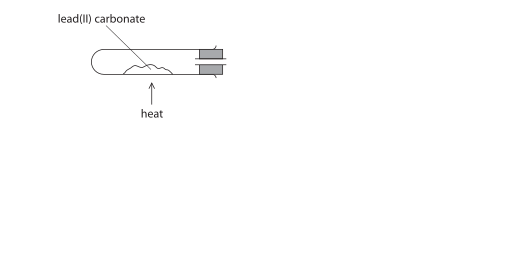
This question is about the oxides of some elements in Group 4 of the Periodic Table. The diagram shows apparatus used to heat lead(II) carbonate. Test tube containing lead(II) carbonate being heated. The open end of the tube is fitted with a bung and delivery tube (not yet shown in the original) for gas to be tested. Complete the diagram to show what needs to be added to the apparatus to test that the gas released is carbon dioxide.

Final answer

See diagram.

lead(II) carbonate limewater heat

Mark scheme points

  1. M1 Diagram shows a delivery tube going into a test tube containing liquid.
  2. M2 The liquid is labelled limewater.

Explanation

To test whether the gas is carbon dioxide, it must be passed through limewater.

  • Add a second open test tube containing a liquid, and draw the delivery tube dipping into the liquid so the gas bubbles through it.
  • Label that liquid as limewater.
  • Do not put a bung on the limewater test tube, because the mark scheme rejects a sealed receiving tube.

If carbon dioxide is present, the limewater would turn milky, but for this question the marks are for the correct apparatus and label.

Common mistakes

  • Stopping the delivery tube above the liquid instead of putting it into the limewater.
  • Leaving the liquid unlabeled, or labeling it as just “water” instead of limewater.
  • Sealing the limewater test tube with a bung.
  • Using the wrong test liquid for carbon dioxide.
  • Examiners reported that this was a common trap: too many delivery tubes did not reach the limewater, even though many students knew the correct label.

Practise This Subtopic

Build a focused practice set on chemical tests, with questions selected from this part of the Edexcel IGCSE Chemistry specification.