Edexcel IGCSE Chemistry Acids, bases and salt preparations questions

Revise the key specification points for Acids, bases and salt preparations, then try focused exam-style questions with worked explanations.

Edexcel IGCSE Chemistry Subtopic 2.g

What You Need To Know

Acids, bases and salt preparations questions can test recall, explanation, calculations, practical method, or data handling. For this subtopic, you should be able to:

  • 2.34 know the general rules for predicting the solubility of ionic compounds in water: common sodium, potassium and ammonium compounds are soluble all nitrates are soluble common chlorides are soluble, except those of silver and lead(II) common sulfates are soluble, except for those of barium, calcium and lead(II) common carbonates are insoluble, except for those of sodium, potassium and ammonium common hydroxides are insoluble except for those of sodium, potassium and calcium (calcium hydroxide is slightly soluble).
  • 2.35 understand acids and bases in terms of proton transfer
  • 2.36 understand that an acid is a proton donor and a base is a proton acceptor
  • 2.37 describe the reactions of hydrochloric acid, sulfuric acid and nitric acid with metals, bases and metal carbonates (excluding the reactions between nitric acid and metals) to form salts
  • 2.38 know that metal oxides, metal hydroxides and ammonia can act as bases, and that alkalis are bases that are soluble in water
  • 2.39 describe an experiment to prepare a pure, dry sample of a soluble salt, starting from an insoluble reactant
  • 2.40C describe an experiment to prepare a pure, dry sample of a soluble salt, starting from an acid and alkali

How To Answer Acids, bases and salt preparations Questions

  1. Start by identifying exactly which specification point the question is testing.
  2. Use the command word carefully: state and identify need a direct answer, while describe and explain need linked detail.
  3. For tables, graphs, diagrams, and practical questions, quote the relevant observation or reading before drawing a conclusion.
  4. When a question asks for a calculation, show the key substitution and include units where they are needed.

Example Questions With Worked Explanations

Example 1: Core Knowledge

Question 1

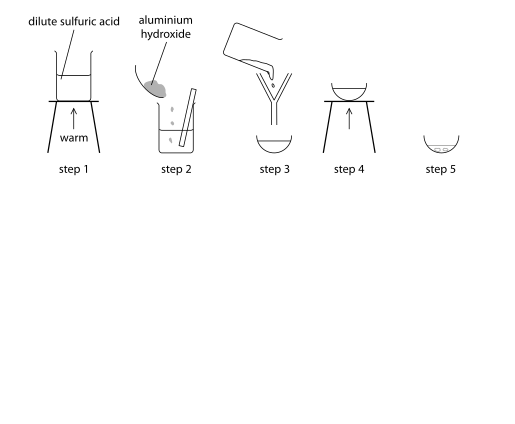
Many different salts can be prepared from acids. A student uses the reaction between aluminium hydroxide and dilute sulfuric acid to prepare a pure, dry sample of aluminium sulfate crystals.
The equation for the reaction used to prepare this salt is
2Al(OH)3 + 3H2SO4 → Al2(SO4)3 + 6H2O

The diagram shows the steps in the student’s method. Sequence diagram of salt preparation steps labelled step 1 to step 5: warming dilute sulfuric acid; adding aluminium hydroxide and stirring; filtering to remove excess solid; heating/evaporating the filtrate to concentrate; cooling to form crystals. State two ways to make sure that all the acid is reacted in step 2.
1

2

Final answer

  1. Use excess aluminium hydroxide.
  2. Stir thoroughly.

Mark scheme points

  1. M1 Use excess aluminium hydroxide.
  2. M2 Stir thoroughly.

Explanation

To make sure all the sulfuric acid has reacted in step 2, you need to ensure there is enough aluminium hydroxide present and that it reacts fully.

  • M1 Adding excess aluminium hydroxide means there is more solid than needed, so all the acid is used up.
  • M2 Stirring thoroughly helps the acid come into contact with the aluminium hydroxide so the reaction can go to completion.

In this method, any extra unreacted aluminium hydroxide can then be removed by filtration in the next step.

Common mistakes

  • Saying only “add enough aluminium hydroxide” is too vague; the key idea is excess.
  • Giving later steps such as filtering, heating or cooling does not answer how to make sure the acid reacts in step 2.
  • Do not suggest adding excess acid; that would leave acid unreacted.
  • Do not forget stirring; it is a separate marking point.
Example 2: Core Knowledge

Question 2

This question is about the insoluble salt silver chloride (AgCl).

Silver chloride can be made by the reaction between copper(II) chloride and silver nitrate.

Turn over

A student investigates the quantity of silver chloride produced when different volumes of silver nitrate solution are added to copper(II) chloride solution.

This is the student’s method.

  • pour 5.0cm3 of copper(II) chloride solution into a test tube
  • add 1.0cm3 of silver nitrate solution to the test tube
  • allow the silver chloride precipitate to settle
  • measure the height of the precipitate

The student repeats the method using different volumes of silver nitrate solution.

The table shows the student’s results.

Volume of silver nitrate
added in cm3
Height of precipitate
in cm
0.00.0
1.00.5
2.01.0
3.01.2
4.02.0
5.02.5
6.03.0
7.03.0
8.03.0

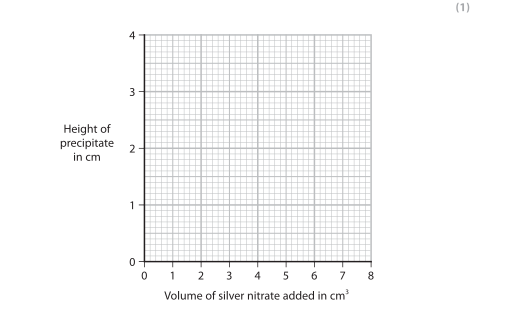
Draw two straight lines of best fit, ignoring the anomalous result.

Blank graph grid to plot height of precipitate (cm) against volume of silver nitrate added (cm³), with axes provided but no plotted points.

Final answer

See diagram. Draw two straight lines that meet at 6.0 cm3, 3.0 cm.

0 1 2 3 4 5 6 7 8 0 1 2 3 4 Volume of silver nitrate added / cm³ Height of precipitate / cm

Mark scheme points

  1. M1 Two straight lines of best fit, meeting at 6 cm3 and 3 cm.

Explanation

  • Draw the first straight line through the rising trend of the results.
  • Ignore the anomalous point at 3.0 cm3, 1.2 cm, so your first line should not be pulled down to pass through it.
  • Draw the second straight line horizontally at 3.0 cm for the plateau.
  • Make sure the two lines meet exactly at 6.0 cm3 and 3.0 cm.

Common mistakes

  • Joining each plotted point one by one instead of drawing two straight best-fit lines.
  • Drawing the first line through the anomalous result at 3.0 cm3, 1.2 cm.
  • Using a sloping second line instead of a horizontal line at 3.0 cm.
  • Making the lines meet at the wrong point instead of at 6.0 cm3, 3.0 cm.

Practise This Subtopic

Build a focused practice set on acids, bases and salt preparations, with questions selected from this part of the Edexcel IGCSE Chemistry specification.