Edexcel IGCSE Chemistry Extraction and uses of metals questions

Revise the key specification points for Extraction and uses of metals, then try focused exam-style questions with worked explanations.

Edexcel IGCSE Chemistry Subtopic 2.e

What You Need To Know

Extraction and uses of metals questions can test recall, explanation, calculations, practical method, or data handling. For this subtopic, you should be able to:

  • 2.22C know that most metals are extracted from ores found in the Earth’s crust and that unreactive metals are often found as the uncombined element
  • 2.23C explain how the method of extraction of a metal is related to its position in the reactivity series, illustrated by carbon extraction for iron and electrolysis for aluminium
  • 2.24C be able to comment on a metal extraction process, given appropriate information detailed knowledge of the processes used in the extraction of a specific metal is not required
  • 2.25C explain the uses of aluminium, copper, iron and steel in terms of their properties the types of steel will be limited to low-carbon (mild), high-carbon and stainless
  • 2.26C know that an alloy is a mixture of a metal and one or more elements, usually other metals or carbon
  • 2.27C explain why alloys are harder than pure metals

How To Answer Extraction and uses of metals Questions

  1. Start by identifying exactly which specification point the question is testing.
  2. Use the command word carefully: state and identify need a direct answer, while describe and explain need linked detail.
  3. For tables, graphs, diagrams, and practical questions, quote the relevant observation or reading before drawing a conclusion.
  4. When a question asks for a calculation, show the key substitution and include units where they are needed.

Example Questions With Worked Explanations

Example 1: Core Knowledge

Question 1

The diagram shows how iron is produced in a blast furnace. Blast furnace diagram with labelled inputs and outputs: limestone and coke added at the top, hot air blown in near the bottom; waste gases leave near the top; molten iron and another product leave at the bottom; raw material P enters near the top. Give the name of raw material P and of product Q.
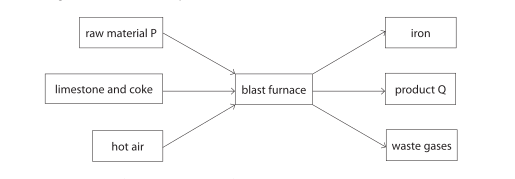
raw material P
product Q

Final answer

  • raw material P: haematite (iron ore)
  • product Q: calcium silicate (slag)

Mark scheme points

  1. M1 P is iron ore or haematite.
  2. M2 Q is calcium silicate, or slag, or CaSiO3.

Explanation

To get full marks, identify the main ore put into the blast furnace and the waste product formed from impurities.

  • The raw material added to provide the iron is iron ore, specifically haematite.
  • Limestone helps remove impurities, producing calcium silicate, which is called slag.

So the two names needed are haematite (iron ore) and calcium silicate (slag).

Common mistakes

  • Putting coke or limestone for P. These are also added, but they are not the raw material labelled P.
  • Giving iron for P. Iron is the product, not the ore put in.
  • Giving waste gases for Q. Q is the other bottom product, which is slag.
  • Writing only a vague answer like ore or waste. Use the specific names haematite and calcium silicate/slag.

Example 2: Using Data and Practical Skills

Question 2

Malachite is an ore of copper containing copper(II) carbonate and several other compounds that are insoluble in water.
You are supplied with several pieces of malachite, these chemicals and items of apparatus.
Chemicals: dilute sulfuric acid    magnesium powder
Apparatus: beakers  filter funnel and paper  pestle and mortar

Describe how you would use the chemicals and the apparatus to obtain a sample of copper from the malachite.

Final answer

  • Method 1:
    • Crush the malachite to a powder using a pestle and mortar.
    • Put the powder in a beaker and add dilute sulfuric acid.
    • Filter the mixture using a filter funnel and paper to remove the insoluble solids.
    • Add magnesium powder to the filtrate, which contains copper(II) sulfate.
    • Filter again and collect the residue. The residue is copper.
  • Accepted alternative: Crush the malachite using a pestle and mortar, add it to dilute sulfuric acid in a beaker and add the magnesium powder. Then filter using a funnel and paper and collect the residue, which is copper.

Mark scheme points

  1. M1 Crush or powder the malachite using the pestle and mortar.
  2. M2 Add the malachite to dilute sulfuric acid in a beaker.
  3. M3 Filter using filter funnel and paper.
  4. M4 Add magnesium powder to the filtrate / solution / copper sulfate.
  5. M5 Collect the residue / copper, for example by filtering again.
  6. M6 Refer to the appropriate use of at least two pieces of apparatus.

Explanation

  • First crush the malachite. Smaller pieces give a larger surface area, so the acid reacts more effectively.
  • Adding dilute sulfuric acid changes the copper compound in malachite into copper(II) sulfate solution. Copper(II) carbonate reacts, but the other insoluble compounds stay solid.
    CuCO3 + H2SO4 → CuSO4 + CO2 + H2O
  • Filtering at this stage removes the insoluble impurities, leaving copper(II) sulfate in the filtrate.
  • Then add magnesium. Magnesium is more reactive than copper, so it displaces copper from copper(II) sulfate solution.
    Mg + CuSO4 → MgSO4 + Cu
  • The copper formed is a solid, so filter again to collect the copper residue.
  • To secure the apparatus mark, say how you use the apparatus, for example: pestle and mortar to crush, beaker to hold the acid and mixture, and filter funnel and paper to separate solids from liquids.

Common mistakes

  • Stopping after making copper(II) sulfate solution. You still need to add magnesium to get copper metal.
  • Collecting the filtrate at the end. The copper is the residue, not the final filtrate.
  • Forgetting to mention crushing the malachite with the pestle and mortar.
  • Naming apparatus without saying how it is used.
  • If you choose the step-by-step route, missing the first filtration means insoluble impurities are not removed before the copper is made.

Practise This Subtopic

Build a focused practice set on extraction and uses of metals, with questions selected from this part of the Edexcel IGCSE Chemistry specification.