Edexcel IGCSE Chemistry Introduction questions

Revise the key specification points for Introduction, then try focused exam-style questions with worked explanations.

Edexcel IGCSE Chemistry Subtopic 4.a

What You Need To Know

Introduction questions can test recall, explanation, calculations, practical method, or data handling. For this subtopic, you should be able to:

  • 4.1 know that a hydrocarbon is a compound of hydrogen and carbon only
  • 4.2 understand how to represent organic molecules using empirical formulae, molecular formulae, general formulae, structural formulae and displayed formulae
  • 4.3 know what is meant by the terms homologous series, functional group and isomerism
  • 4.4 understand how to name compounds relevant to this specification using the rules of International Union of Pure and Applied Chemistry (IUPAC) nomenclature students will be expected to name compounds containing up to six carbon atoms
  • 4.5 understand how to write the possible structural and displayed formulae of an organic molecule given its molecular formula
  • 4.6 understand how to classify reactions of organic compounds as substitution, addition and combustion knowledge of reaction mechanisms is not required

How To Answer Introduction Questions

  1. Start by identifying exactly which specification point the question is testing.
  2. Use the command word carefully: state and identify need a direct answer, while describe and explain need linked detail.
  3. For tables, graphs, diagrams, and practical questions, quote the relevant observation or reading before drawing a conclusion.
  4. When a question asks for a calculation, show the key substitution and include units where they are needed.

Example Questions With Worked Explanations

Example 1: Core Knowledge

Question 1

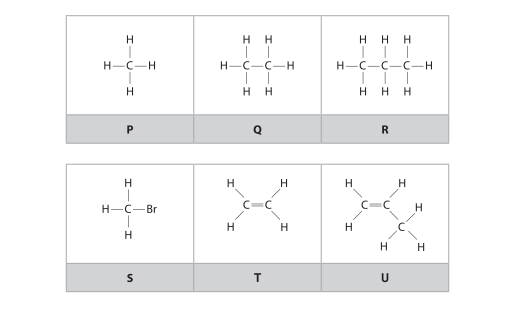
The boxes show the displayed formulae of six organic compounds, P, Q, R, S, T and U. Six displayed formulae in boxes labelled P, Q, R, S, T and U. P is methane (CH4). Q is ethane (C2H6). R is propane (C3H8). S is bromomethane (CH3Br). T is ethene (C2H4) with a C=C double bond. U is propene (C3H6) with a C=C double bond between the first two carbons and a CH3 group on the third carbon. Compounds P, Q and R are members of the same homologous series.
Give two characteristics of a homologous series.
1

2

Final answer

  1. Each member differs from the next by a CH2 group.
  2. Members of the series have the same functional group.

Mark scheme points

  1. M1 Can be represented by a general formula.
  2. M2 Each member differs from the next by a CH2 group.
  3. M3 Each member has the same functional group.
  4. M4 Each member has similar or the same chemical properties / reactions.
  5. M5 There is a trend in physical properties between successive members.

Explanation

You only need any two correct characteristics.

  • A very safe point is that each compound in a homologous series differs from the next one by CH2.
  • Another standard point is that all members have the same functional group.
  • You could also score by saying the series has a general formula, or that members have similar chemical reactions.
  • For physical properties, do not just say they are “the same”. You must say there is a trend, for example boiling point changes along the series.

So a full-mark answer could simply be:

  • Each member differs by CH2.
  • They have the same functional group.

Common mistakes

  • Writing “same physical properties” loses the mark; you need a trend in physical properties.
  • Saying only “they are all hydrocarbons” is not a characteristic of a homologous series.
  • For the CH2 point, say differs from the next by CH2, not just “has more atoms”.
  • Do not give more than one vague idea on the same line; make each characteristic clear and separate.
Example 2: Explaining the Chemistry

Question 2

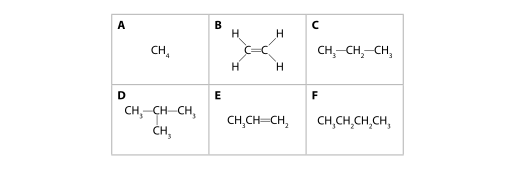
This question is about hydrocarbons. The table shows the formulae of some hydrocarbons. Table of hydrocarbons labelled A to F. A: CH4. B: displayed formula of ethene, H2C=CH2. C: CH3–CH2–CH3. D: CH3–CH(CH3)–CH3. E: CH3CH=CH2. F: CH3CH2CH2CH3. Explain which two letters represent isomers.


Final answer

D and F.

They have the same molecular formula, C4H10, but different structures (the atoms are joined in different ways).

Mark scheme points

  1. M1 D and F
  2. M2 They have the same molecular formula / the same number of each type of atom
  3. M3 They have different structures / different structural formulae / atoms joined together in different ways

Explanation

To identify isomers, look for compounds with:

  • the same molecular formula
  • but a different arrangement of atoms

D is CH3CH(CH3)CH3 and F is CH3CH2CH2CH3. Both contain 4 carbon atoms and 10 hydrogen atoms, so both are C4H10.

However, their structures are different:

  • F is a straight-chain molecule
  • D is a branched-chain molecule

So D and F are isomers.

Common mistakes

  • Choosing molecules with the same number of carbon atoms but not the same molecular formula.
  • Naming the correct letters but not explaining that isomers must have the same molecular formula.
  • Saying they are isomers because they are both hydrocarbons. That is not enough.
  • Forgetting to state that the atoms are arranged differently or joined in different ways.

Practise This Subtopic

Build a focused practice set on introduction, with questions selected from this part of the Edexcel IGCSE Chemistry specification.