Edexcel IGCSE Chemistry Alkanes questions

Revise the key specification points for Alkanes, then try focused exam-style questions with worked explanations.

Edexcel IGCSE Chemistry Subtopic 4.c

What You Need To Know

Alkanes questions can test recall, explanation, calculations, practical method, or data handling. For this subtopic, you should be able to:

  • 4.19 know the general formula for alkanes
  • 4.20 explain why alkanes are classified as saturated hydrocarbons
  • 4.21 understand how to draw the structural and displayed formulae for alkanes with up to five carbon atoms in the molecule, and to name the unbranched-chain isomers
  • 4.22 describe the reactions of alkanes with halogens in the presence of ultraviolet radiation, limited to mono-substitution knowledge of reaction mechanisms is not required

How To Answer Alkanes Questions

  1. Start by identifying exactly which specification point the question is testing.
  2. Use the command word carefully: state and identify need a direct answer, while describe and explain need linked detail.
  3. For tables, graphs, diagrams, and practical questions, quote the relevant observation or reading before drawing a conclusion.
  4. When a question asks for a calculation, show the key substitution and include units where they are needed.

Example Questions With Worked Explanations

Example 1: Core Knowledge

Question 1

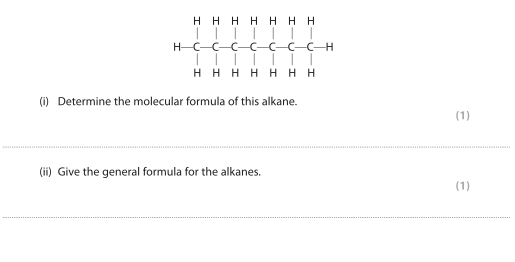
Crude oil is a mixture of hydrocarbons. One of the alkanes in the gasoline fraction has the displayed formula Displayed formula of a straight-chain alkane: a row of carbon atoms single-bonded in a chain with hydrogen atoms shown above and below each carbon and hydrogens at both ends. Give the general formula for the alkanes.
Final answer

CnH2n + 2

Mark scheme points

  1. M1 Gives the general formula for alkanes as CnH2n + 2.

Explanation

To get the mark, write the general formula for alkanes exactly as:

CnH2n + 2

This shows that for an alkane with n carbon atoms, the number of hydrogen atoms is always 2n + 2.

Common mistakes

  • Writing the alkene formula CnH2n instead of the alkane formula.
  • Missing out the + 2 and writing CnH2n.
  • Getting the positions of the symbols wrong, for example writing C2n + 2Hn.
Example 2: Using Data and Practical Skills

Question 2

This question is about alkanes.

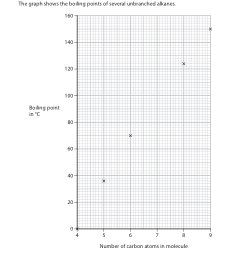
The graph shows the boiling points of several unbranched alkanes.

Graph of boiling point (°C) versus number of carbon atoms in molecule (4 to 9). Plotted points show boiling point increasing with carbon number.

Use the graph to find the boiling point of the alkane with 7 carbon atoms in its molecule.

Show on the graph how you obtain your answer.

boiling point = °C

Final answer

Boiling point = about 100 °C.

See diagram for the lines to show how the answer is obtained.

4 5 6 7 8 9 0 50 100 150 Number of carbon atoms Boiling point / °C about 100 °C

Mark scheme points

  1. M1 Show lines on the graph to read the value.
  2. M2 Read the boiling point correctly as about 100 °C (acceptable range 97–103 °C).

Explanation

To get both marks, you need to show your graph reading method as well as the final value.

  • Find 7 on the horizontal axis and draw a vertical line up to the curve.
  • From where it meets the curve, draw a horizontal line across to the boiling point axis.
  • Read the boiling point from the y-axis. This is about 100 °C.
  • An estimated point placed on the curve at 7 carbon atoms is also fine, as long as the reading is in the accepted range.

Common mistakes

  • Writing a value but not showing any construction lines on the graph.
  • Reading the value from the nearest plotted point instead of interpolating at 7 carbon atoms.
  • Mixing up the axes and using 7 as the temperature instead of the number of carbon atoms.
  • Giving a value outside the acceptable range of 97–103 °C.

Practise This Subtopic

Build a focused practice set on alkanes, with questions selected from this part of the Edexcel IGCSE Chemistry specification.