Edexcel IGCSE Chemistry Crude oil questions

Revise the key specification points for Crude oil, then try focused exam-style questions with worked explanations.

Edexcel IGCSE Chemistry Subtopic 4.b

What You Need To Know

Crude oil questions can test recall, explanation, calculations, practical method, or data handling. For this subtopic, you should be able to:

  • 4.7 know that crude oil is a mixture of hydrocarbons
  • 4.8 describe how the industrial process of fractional distillation separates crude oil into fractions
  • 4.9 know the names and uses of the main fractions obtained from crude oil: refinery gases, gasoline, kerosene, diesel, fuel oil and bitumen
  • 4.10 know the trend in colour, boiling point and viscosity of the main fractions
  • 4.11 know that a fuel is a substance that, when burned, releases heat energy
  • 4.12 know the possible products of complete and incomplete combustion of hydrocarbons with oxygen in the air
  • 4.13 understand why carbon monoxide is poisonous, in terms of its effect on the capacity of blood to transport oxygen references to haemoglobin are not required

How To Answer Crude oil Questions

  1. Start by identifying exactly which specification point the question is testing.
  2. Use the command word carefully: state and identify need a direct answer, while describe and explain need linked detail.
  3. For tables, graphs, diagrams, and practical questions, quote the relevant observation or reading before drawing a conclusion.
  4. When a question asks for a calculation, show the key substitution and include units where they are needed.

Example Questions With Worked Explanations

Example 1: Explaining the Chemistry

Question 1

The diagram shows some important conversion processes used in the oil industry.
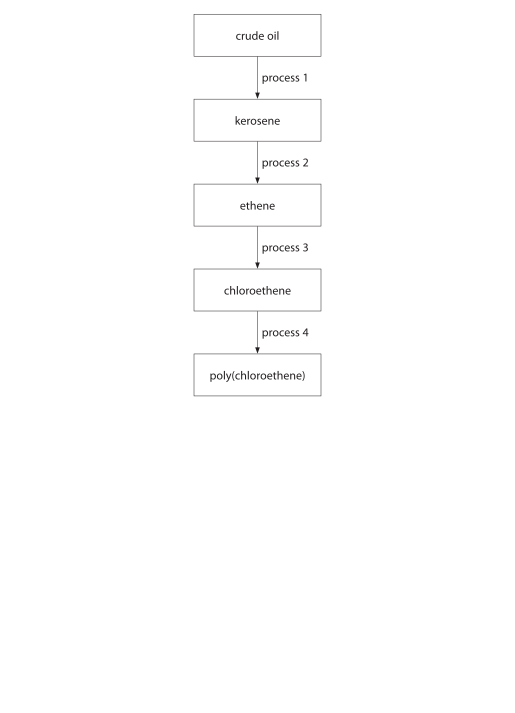
Flow diagram: crude oil is converted to kerosene (process 1), kerosene to ethene (process 2), ethene to chloroethene (process 3), and chloroethene to poly(chloroethene) (process 4).

Describe how kerosene is produced from crude oil in process 1.

Final answer

Kerosene is produced from crude oil by fractional distillation. The crude oil is heated so that it boils/vapourises, and the vapours enter a fractionating column. The column is hotter at the bottom and cooler at the top. As the vapours rise, they cool. Hydrocarbons with different boiling points condense at different levels in the column. Shorter-chain hydrocarbons have lower boiling points and rise higher. Kerosene condenses at its own level in the column, below refinery gases/gasoline and above diesel/fuel oil.

Mark scheme points

Any five of these points gain full marks.

  1. M1 States that the process is fractional distillation.
  2. M2 Says the crude oil is heated or vapourised/boiled.
  3. M3 Refers to a fractionating column or tower.
  4. M4 States that the column is hotter at the bottom than at the top.
  5. M5 Explains that shorter hydrocarbons have lower boiling points and rise higher up the column.
  6. M6 Says that the vapours/fractions condense at different levels depending on their boiling points, so kerosene condenses at its level.

Explanation

To secure full marks, describe separation, not a chemical reaction.

  • Start by naming the process: crude oil is separated by fractional distillation.
  • Then say crude oil is heated strongly so that it vapourises/boils.
  • Mention that the vapours enter a fractionating column.
  • State the temperature gradient: hot at the bottom, cooler at the top.
  • Explain the trend: shorter-chain hydrocarbons have lower boiling points, so they travel further up before condensing.
  • Finish with the key idea that each fraction condenses at the level that matches its boiling point. Kerosene therefore condenses in the middle region of the column, below gasoline/refinery gases and above diesel/fuel oil.

Common mistakes

  • Writing only “fractional distillation” without describing heating, the column, and condensation.
  • Confusing fractional distillation with cracking. Kerosene is separated from crude oil, not made by breaking molecules.
  • Forgetting the temperature gradient: the column must be hotter at the bottom and cooler at the top.
  • Not linking condensation to boiling point.
  • Examiners reported that most candidates earned only one or two of the first three points, while stronger answers reached four or five marks. So do more than name the process: add heating, the column, the temperature gradient, and how kerosene condenses.
Example 2: Explaining the Chemistry

Question 2

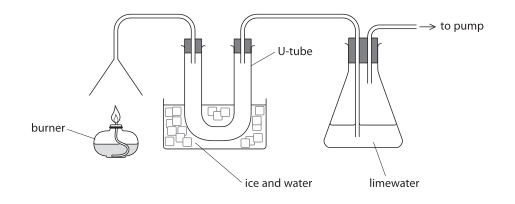
A teacher uses this apparatus to test the products of the combustion of liquid hydrocarbons.
Apparatus diagram: burner producing gases passed through a U-tube in an ice-water bath (to condense water), then into a flask containing limewater, connected to a pump. The equation represents the complete combustion of an alkene.
CnH2n + oxygen → carbon dioxide + nH2O
Complete combustion of 0.0100mol of the alkene produces 2.16g of water. Give a reason why the mass of pure water that collects in the U-tube is less than 2.16g.

Final answer

Some of the water is produced as steam / water vapour, and not all of it condenses in the U-tube, so some is lost to the atmosphere.

Mark scheme points

  1. M1 Some steam / water vapour is lost, or some water vapour does not condense in the U-tube.

Explanation

To get the mark, you must mention steam or water vapour.

  • Combustion produces water at a high temperature, so it is initially formed as water vapour.
  • The U-tube cools the gases and condenses some of this vapour to liquid water.
  • If not all the vapour condenses, some passes through or escapes, so the mass collected is less than 2.16 g.

A short exam-safe answer is: “Some water vapour does not condense, so some is lost.”

Common mistakes

  • Do not say only “water is lost” — you need to say it is lost as steam or water vapour.
  • Do not give incomplete combustion as the reason; this does not earn the mark here.
  • Do not say the water was simply “evaporated away” from the collected liquid; the key idea is that some vapour never condensed.
  • This was poorly answered in past papers: the majority did not mention water vapour or steam, and many wrote evaporation or incomplete combustion, which did not gain credit.

Practise This Subtopic

Build a focused practice set on crude oil, with questions selected from this part of the Edexcel IGCSE Chemistry specification.