Edexcel IGCSE Chemistry Carboxylic acids questions

Revise the key specification points for Carboxylic acids, then try focused exam-style questions with worked explanations.

Edexcel IGCSE Chemistry Subtopic 4.f

What You Need To Know

Carboxylic acids questions can test recall, explanation, calculations, practical method, or data handling. For this subtopic, you should be able to:

  • 4.34C know that carboxylic acids contain the functional group ``` O || —C—OH ```
  • 4.35C understand how to draw structural and displayed formulae for unbranched-chain carboxylic acids with up to four carbon atoms in the molecule, and name each compound
  • 4.36C describe the reactions of aqueous solutions of carboxylic acids with metals and metal carbonates
  • 4.37C know that vinegar is an aqueous solution containing ethanoic acid

How To Answer Carboxylic acids Questions

  1. Start by identifying exactly which specification point the question is testing.
  2. Use the command word carefully: state and identify need a direct answer, while describe and explain need linked detail.
  3. For tables, graphs, diagrams, and practical questions, quote the relevant observation or reading before drawing a conclusion.
  4. When a question asks for a calculation, show the key substitution and include units where they are needed.

Example Questions With Worked Explanations

Example 1: Core Knowledge

Question 1

This question is about organic compounds. The diagram shows the displayed formula of methanoic acid. Displayed formula of methanoic acid: H—C(=O)—O—H. Give the total number of atoms in one molecule of methanoic acid.

Final answer

5

Mark scheme points

  1. M1 Total number of atoms in one molecule of methanoic acid = 5.

Explanation

Count all the atoms shown in the displayed formula of methanoic acid, HCOOH:

  • 1 carbon atom
  • 2 oxygen atoms
  • 2 hydrogen atoms
1 C + 2 O + 2 H = 5 atoms

So the total number of atoms in one molecule is 5.

Common mistakes

  • Forgetting the hydrogen in the –OH group.
  • Counting bonds or double bonds as extra atoms.
  • Giving the number of different types of atoms instead of the total number of atoms.
Example 2: Core Knowledge

Question 2

This question is about carboxylic acids.

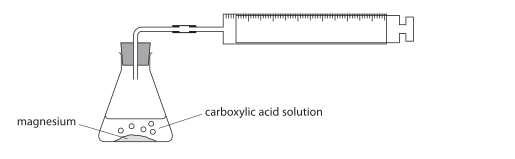
Solutions of carboxylic acids react with magnesium metal to form hydrogen gas.

A student uses this apparatus to investigate the time taken to produce 10cm3 of hydrogen gas from different carboxylic acids.

Experimental setup: conical flask containing magnesium and carboxylic acid solution connected via a bung and delivery tube to a gas syringe to collect hydrogen gas.

This is the student’s method.

  • pour some carboxylic acid solution into a conical flask
  • add some magnesium powder
  • quickly connect the gas syringe and start a timer
  • record the time taken to collect 10cm3 of hydrogen gas

The student repeats the method with three other carboxylic acids.

All the carboxylic acids are of the same concentration.

Give two other variables the student should control in his investigation.

1

2

Final answer

Any two of:

  • volume of carboxylic acid used
  • temperature
  • mass (or moles) of magnesium
  • surface area / size of the magnesium particles or pieces

Mark scheme points

  1. M1 volume of acid
  2. M2 temperature
  3. M3 mass / moles of magnesium
  4. M4 surface area / size of pieces of magnesium

Explanation

To make it a fair test, the student should change only the type of carboxylic acid. Since the concentration is already stated to be the same, two other variables must also be kept constant.

  • Keep the volume of acid the same each time, so the total amount of acid solution is controlled.
  • Keep the temperature the same, because temperature changes the rate of reaction.
  • Keep the mass or moles of magnesium the same, so each test starts with the same amount of metal.
  • Keep the surface area / particle size of magnesium the same, because smaller pieces or finer powder react faster.

You only need any two of these to gain full marks.

Common mistakes

  • Repeating concentration does not gain credit here, because the question already says all the acids have the same concentration.
  • Saying type of acid should be controlled is incorrect; that is the variable being changed.
  • Writing vague answers such as same amount without saying whether it is the acid volume or magnesium mass can lose the mark.
  • Do not give a result, such as time taken or volume of hydrogen, as a control variable.

Practise This Subtopic

Build a focused practice set on carboxylic acids, with questions selected from this part of the Edexcel IGCSE Chemistry specification.