Edexcel IGCSE Chemistry Esters questions

Revise the key specification points for Esters, then try focused exam-style questions with worked explanations.

Edexcel IGCSE Chemistry Subtopic 4.g

What You Need To Know

Esters questions can test recall, explanation, calculations, practical method, or data handling. For this subtopic, you should be able to:

  • 4.38C know that esters contain the functional group ``` O || —C—O— ```
  • 4.39C know that ethyl ethanoate is the ester produced when ethanol and ethanoic acid react in the presence of an acid catalyst
  • 4.40C understand how to write the structural and displayed formulae of ethyl ethanoate
  • 4.41C understand how to write the structural and displayed formulae of an ester, given the name or formula of the alcohol and carboxylic acid from which it is formed and vice versa
  • 4.42C know that esters are volatile compounds with distinctive smells and are used as food flavourings and in perfumes
  • 4.43C practical: prepare a sample of an ester such as ethyl ethanoate

How To Answer Esters Questions

  1. Start by identifying exactly which specification point the question is testing.
  2. Use the command word carefully: state and identify need a direct answer, while describe and explain need linked detail.
  3. For tables, graphs, diagrams, and practical questions, quote the relevant observation or reading before drawing a conclusion.
  4. When a question asks for a calculation, show the key substitution and include units where they are needed.

Example Questions With Worked Explanations

Example 1: Core Knowledge

Question 1

This question is about esters.
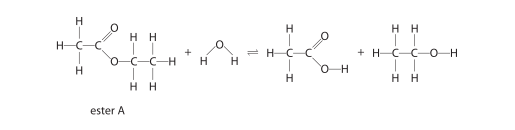
Ester A reacts with water to form ethanoic acid and ethanol.
The displayed formulae of the reactants and products are shown in this equation
Displayed equation showing ester A reacting with water in a reversible reaction to form ethanoic acid and ethanol. Ester A structure corresponds to CH3-COO-CH2-CH3 (an ethanoate ester). Reaction arrow shown as equilibrium (reversible) arrow.
The molar enthalpy change (ΔH) for the reaction is 0kJ/mol.
Draw a ring around the functional group in ester A.

Final answer

See diagram: ring around the ester functional group only.

C H H H C O O C H H C H H H

Mark scheme points

  1. M1 Ring drawn around the ester functional group only: —C(=O)–O—.

Explanation

The functional group in an ester is the —C(=O)–O— part of the molecule. For this displayed formula, your ring must go around only that section.

  • Include the carbonyl carbon, the oxygen double-bonded to it, and the oxygen single-bonded to it.
  • Do not include the carbon atom on the left of the group.
  • Do not include the carbon atom on the right of the group.

This is a 1-mark identification question, so accuracy matters: the ring must show the ester group exactly, not a larger part of the molecule.

Common mistakes

  • Circling the whole molecule instead of just the functional group.
  • Including one of the neighbouring carbon atoms inside the ring.
  • Circling only the C=O part and missing the single-bonded oxygen.
  • Circling only the two oxygen atoms without the carbonyl carbon.
Example 2: Core Knowledge

Question 2

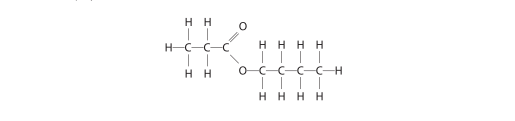
Carboxylic acids react with alcohols to form esters.
The displayed formula of an ester is Displayed formula of an ester: a three-carbon carboxylate part CH3–CH2–C(=O)–O– linked to a four-carbon alkyl chain –CH2–CH2–CH2–CH3 (overall structure CH3CH2COOCH2CH2CH2CH3). Carboxylic acid A and alcohol B react to produce this ester.
Give the displayed formula of carboxylic acid A and of alcohol B.
Carboxylic acid A Alcohol B

Final answer

  • Carboxylic acid A:

    H C C C H H H H O O H
  • Alcohol B:

    H C C C C O H H H H H H H H H

Mark scheme points

  1. M1 Displayed formula of propanoic acid, CH3CH2COOH.
  2. M2 Displayed formula of butan-1-ol, CH3CH2CH2CH2OH.

Explanation

Work backwards from the ester group, which is –C(=O)–O–.

  • M1 The part on the left of the ester link is CH3CH2C(=O)–. This comes from the carboxylic acid, so replace the ester oxygen link with –OH. That gives propanoic acid, shown as CH3CH2COOH in displayed form.
  • M2 The part on the right of the ester link is –CH2CH2CH2CH3. This comes from the alcohol, so attach –OH to that carbon chain. That gives butan-1-ol, shown as CH3CH2CH2CH2OH in displayed form.

For full marks, make sure your displayed formulae show every bond and every H atom.

Common mistakes

  • Splitting the ester in the wrong place. The acid must contain the C=O group.
  • Giving butanoic acid and propan-1-ol instead of propanoic acid and butan-1-ol.
  • Not drawing a displayed formula fully: missing H atoms or missing bonds can lose the mark.
  • Putting OH on both fragments. If everything else is correct, that only reaches 1 mark.

Practise This Subtopic

Build a focused practice set on esters, with questions selected from this part of the Edexcel IGCSE Chemistry specification.