Edexcel IGCSE Chemistry Alkenes questions

Revise the key specification points for Alkenes, then try focused exam-style questions with worked explanations.

Edexcel IGCSE Chemistry Subtopic 4.d

What You Need To Know

Alkenes questions can test recall, explanation, calculations, practical method, or data handling. For this subtopic, you should be able to:

  • 4.23 know that alkenes contain the functional group >C=C<
  • 4.24 know the general formula for alkenes
  • 4.25 explain why alkenes are classified as unsaturated hydrocarbons
  • 4.26 understand how to draw the structural and displayed formulae for alkenes with up to four carbon atoms in the molecule, and name the unbranched-chain isomers knowledge of cis/trans or E/Z notation is not required
  • 4.27 describe the reactions of alkenes with bromine to produce dibromoalkanes
  • 4.28 describe how bromine water can be used to distinguish between an alkane and an alkene

How To Answer Alkenes Questions

  1. Start by identifying exactly which specification point the question is testing.
  2. Use the command word carefully: state and identify need a direct answer, while describe and explain need linked detail.
  3. For tables, graphs, diagrams, and practical questions, quote the relevant observation or reading before drawing a conclusion.
  4. When a question asks for a calculation, show the key substitution and include units where they are needed.

Example Questions With Worked Explanations

Example 1: Explaining the Chemistry

Question 1

The table shows the displayed formulae of four hydrocarbons, W, X, Y and Z.
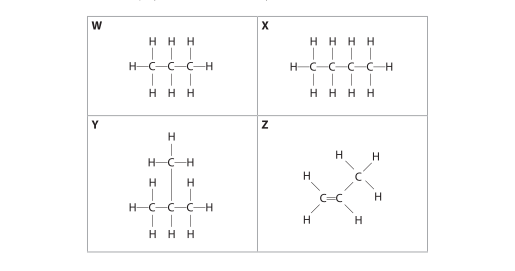
Displayed formulae labelled W, X, Y and Z. W is a 3-carbon straight-chain alkane. X is a 4-carbon straight-chain alkane. Y is a branched alkane with 4 carbons (one carbon branching off the middle carbon). Z is a 3-carbon alkene with one C=C double bond (propene-type structure).

Z is an unsaturated hydrocarbon.

Explain what is meant by the term unsaturated hydrocarbon.

unsaturated

hydrocarbon

Final answer

  • unsaturated: contains a carbon–carbon double bond
  • hydrocarbon: a compound containing hydrogen and carbon only

Mark scheme points

  1. M1 States that unsaturated means it contains a carbon–carbon double bond.
  2. M2 States that a hydrocarbon is a compound / molecule / substance containing hydrogen and carbon.
  3. M3 States that it contains hydrogen and carbon only.

Explanation

To get full marks, define each word separately.

  • For unsaturated, you must say there is a carbon–carbon double bond. That is the key idea.
  • For hydrocarbon, you must say it is a compound made of hydrogen and carbon.
  • To secure the final mark, include only: a hydrocarbon contains hydrogen and carbon only, with no other elements present.

A full-mark definition is therefore: an unsaturated hydrocarbon is a compound containing only hydrogen and carbon, with a carbon–carbon double bond.

Common mistakes

  • Saying unsaturated means “not full of hydrogen” without mentioning a C=C double bond.
  • Forgetting the word only when defining hydrocarbon.
  • Calling a hydrocarbon an element or a mixture instead of a compound or molecule.
  • Giving examples or reactions instead of a direct definition.
Example 2: Explaining the Chemistry

Question 2

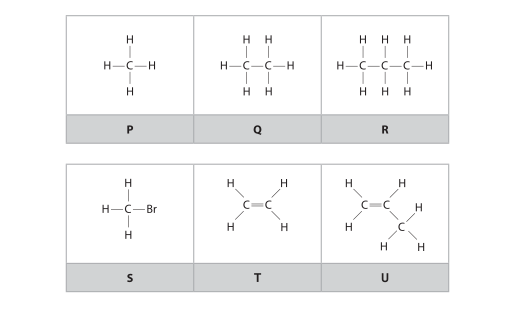
The boxes show the displayed formulae of six organic compounds, P, Q, R, S, T and U. Six displayed formulae in boxes labelled P, Q, R, S, T and U. P is methane (CH4). Q is ethane (C2H6). R is propane (C3H8). S is bromomethane (CH3Br). T is ethene (C2H4) with a C=C double bond. U is propene (C3H6) with a C=C double bond between the first two carbons and a CH3 group on the third carbon. Describe a test that can be used to distinguish between compounds Q and T.
test

result with compound Q

result with compound T

Final answer

  • Using bromine water:
    test: add bromine water
    result with compound Q: no change / stays orange
    result with compound T: bromine water is decolourised / changes from orange to colourless
  • Allowed alternative:
    test: add acidified potassium manganate(VII)
    result with compound Q: no change / stays purple
    result with compound T: decolourised / goes colourless

Mark scheme points

  1. M1 Add bromine water, Br2(aq).
  2. M2 With compound Q: no change / stays orange.
  3. M3 With compound T: bromine water is decolourised / changes from orange to colourless.

Explanation

To get all 3 marks, you need one correct reagent and the different result for each compound.

Use bromine water because it distinguishes an alkane from an alkene.

  • Compound Q is ethane, an alkane. It does not react with bromine water, so the colour stays orange.
  • Compound T is ethene, an alkene. It reacts because it contains a C=C double bond, so bromine water is decolourised and goes colourless.

If you use the alternative test, acidified potassium manganate(VII), then Q stays purple and T is decolourised.

Common mistakes

  • Not naming a reagent at all. If you only write the two results, you can only get limited credit.
  • Mixing up the results: the alkane shows no change, the alkene decolourises the bromine water.
  • Writing discoloured. The accepted wording is decolourised or changes to colourless.
  • Using the wrong reagent. A correct colour change with an incorrect reagent does not score.

Practise This Subtopic

Build a focused practice set on alkenes, with questions selected from this part of the Edexcel IGCSE Chemistry specification.