Edexcel IGCSE Chemistry Reversible reactions and equilibria questions

Revise the key specification points for Reversible reactions and equilibria, then try focused exam-style questions with worked explanations.

Edexcel IGCSE Chemistry Subtopic 3.c

What You Need To Know

Reversible reactions and equilibria questions can test recall, explanation, calculations, practical method, or data handling. For this subtopic, you should be able to:

  • 3.17 know that some reactions are reversible and this is indicated by the symbol ⇌ in equations
  • 3.18 describe reversible reactions such as the dehydration of hydrated copper(II) sulfate and the effect of heat on ammonium chloride
  • 3.19C know that a reversible reaction can reach dynamic equilibrium in a sealed container
  • 3.20C know that the characteristics of a reaction at dynamic equilibrium are: the forward and reverse reactions occur at the same rate the concentrations of reactants and products remain constant.
  • 3.21C understand why a catalyst does not affect the position of equilibrium in a reversible reaction
  • 3.22C know the effect of changing either temperature or pressure on the position of equilibrium in a reversible reaction: an increase (or decrease) in temperature shifts the position of equilibrium in the direction of the endothermic (or exothermic) reaction an increase (or decrease) in pressure shifts the position of equilibrium in the direction that produces fewer (or more) moles of gas References to Le Chatelier's principle are not required

How To Answer Reversible reactions and equilibria Questions

  1. Start by identifying exactly which specification point the question is testing.
  2. Use the command word carefully: state and identify need a direct answer, while describe and explain need linked detail.
  3. For tables, graphs, diagrams, and practical questions, quote the relevant observation or reading before drawing a conclusion.
  4. When a question asks for a calculation, show the key substitution and include units where they are needed.

Example Questions With Worked Explanations

Example 1: Core Knowledge

Question 1

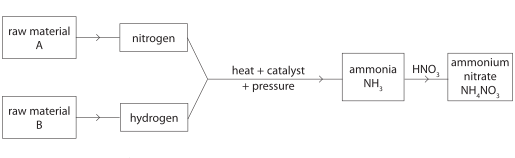
The diagram shows the manufacture of ammonia by the Haber process and its conversion into the fertiliser ammonium nitrate. Flow diagram: raw material A and raw material B feed into a process producing nitrogen and hydrogen, which react (heat + catalyst + pressure) to form ammonia NH3. Ammonia then reacts with HNO3 to form ammonium nitrate NH4NO3. Labels include 'nitrogen', 'hydrogen', 'ammonia NH3', 'ammonium nitrate NH4NO3', and 'HNO3'. State the temperature, pressure and catalyst used to convert the mixture of nitrogen and hydrogen into ammonia.
temperature
pressure
catalyst

Final answer

  • temperature: 400–500 °C
  • pressure: 150–250 atmospheres
  • catalyst: iron (Fe)

Mark scheme points

  1. M1 Temperature given as 400 to 500 °C.
  2. M2 Pressure given as 150 to 250 atmospheres.
  3. M3 Catalyst identified as iron / Fe.

Explanation

To score all 3 marks, give the three Haber process conditions separately and include the correct units for temperature and pressure.

  • The temperature must be in the range 400–500 °C.
  • The pressure must be in the range 150–250 atmospheres.
  • The catalyst is iron, symbol Fe.

Accepted alternatives include temperature in kelvin (623–823 K) and pressure in bar. The safest exam answer is to write the values exactly as above.

Common mistakes

  • Leaving out the units for temperature and pressure.
  • Giving a single value that is outside the accepted range.
  • Writing the catalyst as iron oxide instead of iron.
  • Mixing up the catalyst with the reactants, for example naming nitrogen or hydrogen.
Example 2: Using Data and Practical Skills

Question 2

Ammonia is manufactured on a large scale and is used to make fertilisers such as ammonium nitrate (NH4NO3).
(a) The first stage in the manufacture of ammonium nitrate is to react ammonia gas with oxygen gas.
4NH3(g) + 5O2(g) ⇌ 4NO(g) + 6H2O(g)   ΔH = −907 kJ/mol
The reaction is carried out at a pressure of about 10 atm and at a temperature of 800 °C, in the presence of a catalyst.
If the mixture is left for long enough in a sealed container, the reaction reaches a position of dynamic equilibrium.
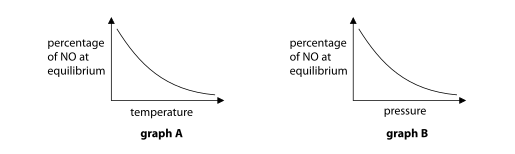
Graph A shows how the percentage of nitrogen monoxide (NO) in the equilibrium mixture varies with temperature at constant pressure.
Graph B shows how the percentage of nitrogen monoxide (NO) in the equilibrium mixture varies with pressure at constant temperature.
Two schematic graphs labelled graph A and graph B. In both, the y-axis is 'percentage of NO at equilibrium'. Graph A plots against temperature and shows a decreasing curve as temperature increases. Graph B plots against pressure and shows a decreasing curve as pressure increases.
(i) Explain why the percentage of NO at equilibrium decreases in each case.
Graph A
Graph B

Final answer

Graph A: The forward reaction is exothermic, so the reverse reaction is endothermic. Increasing the temperature favours the endothermic reverse reaction, so the equilibrium shifts to the left and the percentage of NO decreases.

Graph B: There are fewer moles of gas on the left-hand side than on the right-hand side (4NH3 + 5O2 = 9 moles; 4NO + 6H2O = 10 moles). Increasing the pressure shifts the equilibrium to the left, so the percentage of NO decreases.

Mark scheme points

  1. M1 For Graph A: state that the backward/reverse reaction is endothermic.
  2. M2 Link this to temperature: increasing temperature shifts the equilibrium to the left, so the percentage of NO decreases.
  3. M3 For Graph B: state that there are fewer moles (molecules) of gas on the left-hand side.
  4. M4 Link this to pressure: increasing pressure shifts the equilibrium to the left, so the percentage of NO decreases.

Explanation

For Graph A, use the energy change first. The equation has ΔH = −907 kJ/mol, so the forward reaction is exothermic. That means the reverse reaction is endothermic. When temperature increases, equilibrium moves in the endothermic direction, which is to the left. Since NO is on the right, its percentage at equilibrium falls.

For Graph B, compare the number of gas moles on each side:

Left: 4NH3 + 5O2 = 9 moles of gas
Right: 4NO + 6H2O = 10 moles of gas

The left-hand side has fewer moles of gas. Increasing pressure shifts equilibrium to the side with fewer moles, so it shifts to the left. This reduces the amount of NO in the equilibrium mixture.

Common mistakes

  • For Graph A, do not just say “temperature changes the equilibrium” — you must state that the reverse reaction is endothermic or that the forward reaction is exothermic.
  • For Graph B, make sure you count gas moles correctly: left = 9, right = 10, so the shift is to the left at higher pressure.
  • Do not say the equilibrium shifts right in either graph; that would increase NO, which contradicts the graph.
  • Do not talk about the catalyst here — a catalyst changes the rate of reaching equilibrium, not the position of equilibrium.

Practise This Subtopic

Build a focused practice set on reversible reactions and equilibria, with questions selected from this part of the Edexcel IGCSE Chemistry specification.