Edexcel IGCSE Chemistry Rates of reaction questions

Revise the key specification points for Rates of reaction, then try focused exam-style questions with worked explanations.

Edexcel IGCSE Chemistry Subtopic 3.b

What You Need To Know

Rates of reaction questions can test recall, explanation, calculations, practical method, or data handling. For this subtopic, you should be able to:

  • 3.9 describe experiments to investigate the effects of changes in surface area of a solid, concentration of a solution, temperature and the use of a catalyst on the rate of a reaction
  • 3.10 describe the effects of changes in surface area of a solid, concentration of a solution, pressure of a gas, temperature and the use of a catalyst on the rate of a reaction
  • 3.11 explain the effects of changes in surface area of a solid, concentration of a solution, pressure of a gas and temperature on the rate of a reaction in terms of particle collision theory
  • 3.12 know that a catalyst is a substance that increases the rate of a reaction, but is chemically unchanged at the end of the reaction
  • 3.13 know that a catalyst works by providing an alternative pathway with lower activation energy
  • 3.14C draw and explain reaction profile diagrams showing ΔH and activation energy
  • 3.15 practical: investigate the effect of changing the surface area of marble chips and of changing the concentration of hydrochloric acid on the rate of reaction between marble chips and dilute hydrochloric acid

How To Answer Rates of reaction Questions

  1. Start by identifying exactly which specification point the question is testing.
  2. Use the command word carefully: state and identify need a direct answer, while describe and explain need linked detail.
  3. For tables, graphs, diagrams, and practical questions, quote the relevant observation or reading before drawing a conclusion.
  4. When a question asks for a calculation, show the key substitution and include units where they are needed.

Example Questions With Worked Explanations

Example 1: Using Data and Practical Skills

Question 1

Hydrogen peroxide decomposes to form water and oxygen.
This decomposition is shown in the equation.
2H2O2 → 2H2O + O2 The student adds 100cm3 of hydrogen peroxide solution at 20°C to the apparatus labelled A.
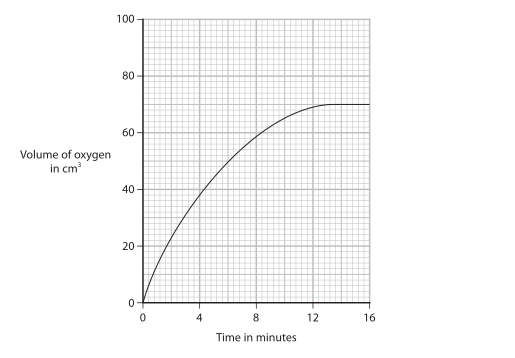
The student records the volume of oxygen gas collected every minute for 16 minutes.
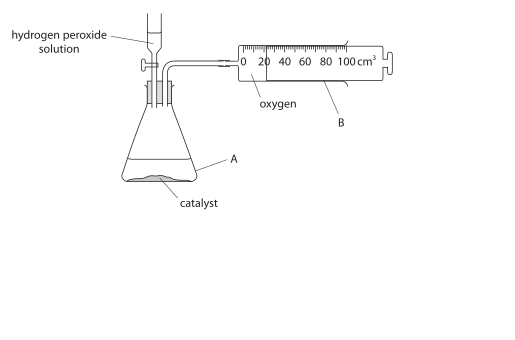
The graph shows the student’s results. Graph of volume of oxygen (cm³) against time (minutes) from 0 to 16. Curve rises steeply at first then levels off, approaching a maximum volume around 70 cm³ by about 14–16 minutes. A student uses this apparatus to investigate the rate of decomposition of hydrogen peroxide solution. Apparatus diagram: hydrogen peroxide solution is added via a dropping funnel into a conical flask containing a catalyst. The flask is connected by a delivery tube to a gas syringe (graduated 0 to 100 cm³) to collect oxygen. Labels A (flask) and B (gas syringe) are shown. Name the pieces of apparatus labelled A and B.
A
B

Final answer

A: conical flask

B: gas syringe

Mark scheme points

  1. M1 A = (conical) flask
  2. M2 B = (gas) syringe

Explanation

To get both marks, name each labelled piece of apparatus exactly.

  • A is the conical flask, the vessel where the hydrogen peroxide reaction happens.
  • B is the gas syringe, which collects and measures the volume of oxygen produced.

You do not need extra detail here; the correct apparatus names are enough.

Common mistakes

  • Naming A as just “flask” is usually less precise than “conical flask”.
  • Confusing B with a measuring cylinder or burette instead of a gas syringe.
  • Naming other apparatus in the diagram, such as the dropping funnel or delivery tube, instead of the labelled parts.
Example 2: Using Data and Practical Skills

Question 2

Hydrogen peroxide solution decomposes slowly at room temperature to form water and oxygen.
The equation for the reaction is
2H2O2 → 2H2O + O2 A student has samples of three solids, X, Y and Z.
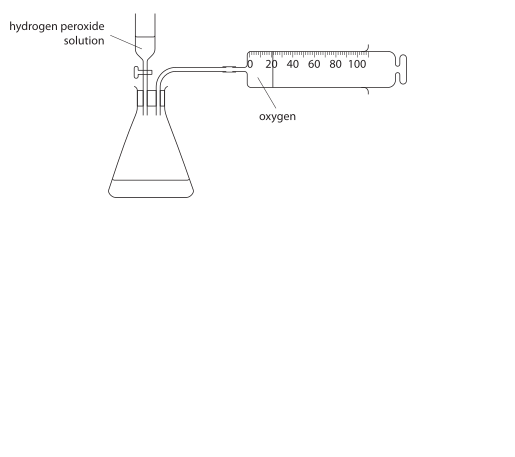
The student uses this apparatus to find out which solids act as catalysts in the decomposition of hydrogen peroxide solution.
Apparatus diagram for measuring oxygen from hydrogen peroxide decomposition: conical flask connected by delivery tube to a horizontal gas syringe (graduated 0–100 cm^3) to collect oxygen; hydrogen peroxide solution is added via a dropping funnel into the flask containing a solid catalyst sample. Describe the method that the student should use to find out which solids act as catalysts.


Final answer

  • Set up the apparatus and first do a control experiment using a known volume of hydrogen peroxide solution only, with no solid added.
  • Measure the time taken to collect a fixed volume of oxygen in the gas syringe, or measure the volume of oxygen collected in a fixed time.
  • Repeat using the same volume of hydrogen peroxide solution with a known mass of solid X. Then repeat in the same way with Y and with Z.
  • Each time, measure the time for the same volume of oxygen to be collected, or the volume collected in the same time.
  • After each reaction, remove the solid by filtration, dry it and measure its mass again to check that its mass is unchanged.
  • A solid acts as a catalyst if oxygen is produced faster than in the control experiment (shorter time / larger volume in the same time) and the solid is unchanged in mass at the end.

Mark scheme points

  1. M1 Do an experiment using hydrogen peroxide solution only, without X, Y or Z.
  2. M2 Use a known volume of hydrogen peroxide solution.
  3. M3 Measure the time for a certain volume of oxygen to be collected, or measure the volume collected in a certain time.
  4. M4 Repeat using the same volume of hydrogen peroxide solution.
  5. M5 Use a known mass or amount of solid X, then Y, then Z.
  6. M6 Measure the time for the same volume of oxygen to be collected, or the volume collected in the same time period with each solid present.
  7. M7 After the reaction, remove the solid, dry it and find its mass again, or check that its mass is unchanged.
  8. M8 A reduced time for a fixed volume of oxygen, or an increased volume in a fixed time, means the solid is a possible catalyst.

Explanation

To get full marks, describe a fair comparison and include a control. Start with hydrogen peroxide solution on its own. This shows how fast it decomposes without any catalyst.

Then say that you use a known volume of hydrogen peroxide each time. You must also make the comparison in the same way each time: either:

  • measure the time taken to collect a fixed volume of O2, or
  • measure the volume of O2 collected in a fixed time.

Next, repeat the experiment with the same volume of hydrogen peroxide and a known mass of X, then Y, then Z. Using the same conditions makes the results comparable.

Finally, explain how you decide whether each solid is a catalyst:

  • if oxygen is produced faster than in the control, the solid increases the rate;
  • if the solid is unchanged in mass after filtering, drying and reweighing, it has not been used up.

A solid that makes the reaction faster and is unchanged at the end acts as a catalyst.

Common mistakes

  • Forgetting the control experiment with hydrogen peroxide only. Without this, you cannot tell whether a solid actually speeds up the reaction.
  • Writing vague statements such as “see which one bubbles more” instead of giving a measurable method using time and gas volume.
  • Not saying that the same volume of hydrogen peroxide and the same gas measurement method must be used for each test.
  • Missing the check that the solid is unchanged after the reaction; a catalyst should not be used up.
  • Examiners reported that many candidates found this hard to even start. The strongest answers began with a control experiment and then clearly compared time/volume results for X, Y and Z.

Practise This Subtopic

Build a focused practice set on rates of reaction, with questions selected from this part of the Edexcel IGCSE Chemistry specification.