Edexcel IGCSE Chemistry Energetics questions

Revise the key specification points for Energetics, then try focused exam-style questions with worked explanations.

Edexcel IGCSE Chemistry Subtopic 3.a

What You Need To Know

Energetics questions can test recall, explanation, calculations, practical method, or data handling. For this subtopic, you should be able to:

  • 3.1 know that chemical reactions in which heat energy is given out are described as exothermic, and those in which heat energy is taken in are described as endothermic
  • 3.2 describe simple calorimetry experiments for reactions such as combustion, displacement, dissolving and neutralisation
  • 3.3 calculate the heat energy change from a measured temperature change using the expression Q = mcΔT
  • 3.4 calculate the molar enthalpy change (ΔH) from the heat energy change, Q
  • 3.5C draw and explain energy level diagrams to represent exothermic and endothermic reactions
  • 3.6C know that bond-breaking is an endothermic process and that bond-making is an exothermic process
  • 3.7C use bond energies to calculate the enthalpy change during a chemical reaction

How To Answer Energetics Questions

  1. Start by identifying exactly which specification point the question is testing.
  2. Use the command word carefully: state and identify need a direct answer, while describe and explain need linked detail.
  3. For tables, graphs, diagrams, and practical questions, quote the relevant observation or reading before drawing a conclusion.
  4. When a question asks for a calculation, show the key substitution and include units where they are needed.

Example Questions With Worked Explanations

Example 1: Core Knowledge

Question 1

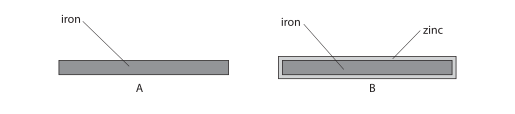
The diagram shows two samples of iron, A and B. Diagram of two rectangular samples labelled A and B. Sample A is iron. Sample B is iron coated with a thin outer layer labelled zinc. Sample B is coated with a thin layer of zinc. Iron can be formed by reacting aluminium powder with iron(III) oxide.
The diagram shows how this reaction can be demonstrated. Diagram of a container holding a mixture labelled aluminium powder and iron(III) oxide powder, with a magnesium fuse inserted from above. The fuse is lit to start the reaction. When the magnesium fuse is lit, a very exothermic reaction occurs. State the meaning of the term exothermic.

Final answer

An exothermic reaction is one that gives out heat energy.

Mark scheme points

  1. M1 States that the reaction gives out / releases / produces heat energy (or thermal energy).

Explanation

To get the mark, your definition must say that heat is given out by the reaction.

  • Good wording: gives out heat energy
  • Also acceptable: releases thermal energy
  • Do not just write gives out energy, because the mark requires heat or thermal energy.

Common mistakes

  • Writing only gives out energy without mentioning heat or thermal energy.
  • Confusing exothermic with endothermic and saying takes in heat.
  • Describing the reaction as just hot instead of defining what happens to heat energy.

Example 2: Using Data and Practical Skills

Question 2

A student investigates the temperature change during the reaction between zinc metal and copper(II) sulfate solution.
The student considers two different methods. Two method diagrams: Method 1 shows a polystyrene cup with a thermometer inserted; Method 2 shows a glass bottle with a bung and thermometer inserted.
Method 1
polystyrene cup
  • pour 50cm3 of copper(II) sulfate solution into the polystyrene cup
  • record the temperature of the solution
  • add 3g of zinc powder
  • stir using the thermometer and record the highest temperature reached
Method 2
glass bottle
bung
  • record the temperature of 50cm3 of copper(II) sulfate solution
  • pour the 50cm3 of copper(II) sulfate solution into the glass bottle
  • add 3g of zinc powder
  • push the bung and thermometer into the bottle and record the highest temperature reached
Discuss the advantages and disadvantages of each method.

Final answer

  • Method 1 advantages: the polystyrene cup is an insulator, so it reduces heat loss; stirring with the thermometer helps keep the temperature even, so the highest temperature is more accurate.
  • Method 1 disadvantages: there is no lid, so heat is lost to the surroundings; it also has a greater risk of spillage / the cup is less stable and may fall over.
  • Method 2 advantages: the bung reduces heat loss to the surroundings; the bung also reduces spillage.
  • Method 2 disadvantages: glass is a poor insulator, so heat is lost; the mixture cannot be stirred, so the temperature may not be even and the highest temperature may be less accurate.

Mark scheme points

  1. M1 Method 1: polystyrene is an insulator, so it reduces or prevents heat loss to the surroundings.
  2. M2 Method 1: there is no lid, so heat / thermal energy is lost to the surroundings.
  3. M3 Method 1: stirring helps give an even temperature, so the highest temperature is more accurate.
  4. M4 Method 1: without a lid there is a possibility of spillage, or the cup with thermometer is unstable and may fall over.
  5. M5 Method 2: glass is a poor insulator, so heat / thermal energy is lost.
  6. M6 Method 2: the bung helps reduce or prevent heat loss to the surroundings.
  7. M7 Method 2: the bung prevents / reduces spillage.
  8. M8 Method 2: the mixture cannot be stirred, so the temperature may not be even throughout and the highest temperature may be less accurate.

Explanation

To get full marks, compare both methods by giving clear advantages and disadvantages for each one.

  • Method 1: a polystyrene cup is better for insulation, so less heat escapes. This makes the temperature change closer to the true value.
  • Method 1: because there is no lid, some heat still escapes to the air.
  • Method 1: stirring is useful because it spreads the heat evenly through the solution, so the thermometer reading is more reliable.
  • Method 1: an open cup is easier to spill, and it can be less stable than a bottle.
  • Method 2: the bung is helpful because it reduces heat loss and also makes spillage less likely.
  • Method 2: however, glass is not a good insulator compared with polystyrene, so more heat is lost through the container.
  • Method 2: the bottle is closed, so you cannot stir the mixture. That means the temperature may not be the same throughout, so the maximum temperature recorded may be less accurate.

A strong answer uses words like insulator, heat loss, even temperature, accurate highest temperature, and spillage.

Common mistakes

  • Do not say glass is a better insulator than polystyrene; it is the other way round.
  • Do not say the bung stops heat loss completely; it only reduces it.
  • Do not explain stirring by saying it increases the rate of reaction; the credit is for making the temperature even and improving accuracy.
  • Do not forget a disadvantage for Method 2: without stirring, the temperature may be uneven.
  • Do not describe only one method; you need advantages and disadvantages of each method.

Practise This Subtopic

Build a focused practice set on energetics, with questions selected from this part of the Edexcel IGCSE Chemistry specification.